5 Deload Signals Worth Acting On After 40
Quick Answer: After 40 the useful deload triggers are: a resting heart rate five or more beats above your baseline for three consecutive mornings, a warm-up that stops working, grip strength that fades earlier than usual in a session, sleep that fragments in the second half of the night, and enthusiasm that drops without an obvious reason. Any two together for a week is a deload week, which usually means keeping the sessions and cutting volume by about 40 percent while holding intensity.
The numbers on the bar are the last thing to fall, which is why waiting for them is how a deload becomes a layoff.
Here are the five signals that show up first, what each one looks like specifically, and what to do about them.

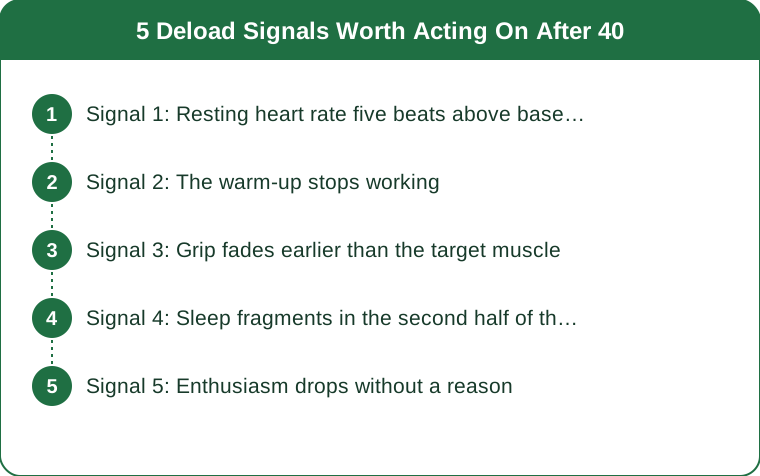
Signal 1: Resting heart rate five beats above baseline for three mornings
This is the most objective signal on the list and the easiest to collect. Any wearable or a manual count on waking gives you the number, and after two weeks you have a personal baseline to compare against.
Five beats is the threshold worth acting on, and the three-morning requirement is what separates a real trend from a warm night, a late meal, or one glass of wine. A single elevated morning means nothing.
It rises for several reasons that all point the same direction: accumulated training stress, poor sleep, incipient illness, dehydration, and life stress. You do not need to know which one, because the response is the same in each case.
After 40 this signal becomes more useful rather than less, because recovery capacity has more variance week to week and the drift shows up earlier relative to performance decline than it did at 25.
The response: cut volume by about 40 percent for the week, keep the intensity of the working sets, and reassess on the following Monday. Most people find the number returns to baseline within four to six days.
Signal 2: The warm-up stops working
A warm-up that used to take ten minutes and now takes twenty-five without producing the same result is a specific and reliable signal, and it is one of the earliest.
What it feels like: joints stay stiff through the second and third set, the first working set feels like a maximal effort, and the session only comes together halfway through - if at all.
Why it happens: tissue that has not fully recovered stays stiffer and less responsive, and the extra warm-up is you compensating for the incomplete recovery rather than preparing a recovered body.
This is distinct from the normal lengthening of warm-ups after 40, which is real and permanent. The signal is the change from your own current normal, not the comparison to your thirties.
The response: keep training but move the hard work later in the session, and if the effect persists more than a week alongside any other signal here, deload.

Signal 3: Grip fades earlier than the target muscle
When your hands give out before your back on rows or pulls, and that is not usually how your sessions go, it points to systemic fatigue rather than a grip weakness.
Grip is a sensitive fatigue marker because it depends on forearm endurance and neural drive, both of which degrade under accumulated fatigue before larger, stronger muscle groups show any change.
A practical test: note the set on which your grip becomes the limiting factor in a familiar exercise. If that happens two sets earlier than it did a fortnight ago at the same weight, take it seriously.
Straps mask this signal completely, which is worth knowing. If you use straps for everything, run one strapless set per session purely as a diagnostic.
The response: it rarely justifies a deload on its own but it is a strong supporting signal. Paired with any other one here, it moves the decision from maybe to yes.
Signal 4: Sleep fragments in the second half of the night
The specific pattern is falling asleep normally and then waking repeatedly after around three in the morning, which is different from difficulty falling asleep and points in a different direction.
It is commonly associated with elevated cortisol and sympathetic activity, which is what accumulated training and life stress produce together. Falling asleep easily but not staying asleep is the classic overreaching sleep pattern.
After 40 this is confounded by plenty of other things - hormonal changes, alcohol, temperature, a warm August bedroom - which is why it is a signal to weigh rather than a diagnosis.
Look for the change relative to your own recent weeks, and note whether it coincided with a jump in training volume, because that association is usually visible in hindsight.
The response: deload and address sleep directly at the same time. Cooler room, no alcohol for the week, earlier last meal. Sleep is the recovery mechanism, so a deload that does not fix sleep achieves considerably less.
Signal 5: Enthusiasm drops without a reason
Not dreading a hard session - that is normal - but a flat indifference toward training you usually look forward to. This is a well-documented feature of overreaching and it is consistently underrated because it feels like a character issue rather than a physiological one.
Central fatigue affects motivation directly, through neurotransmitter and hormonal changes, which is why the feeling arrives before any measurable drop in strength.
The distinguishing question: is it specific or general? Losing interest in training while everything else feels normal points to training load. Losing interest in most things points somewhere else entirely and is worth talking to someone about.
Do not train through this one on discipline alone. It is the signal most people are proudest of ignoring, and it precedes the deepest holes.
The response: a full deload week, and consider two. Motivation typically returns before physical markers fully normalize, which makes it a useful early indicator in both directions.
How to run the deload itself: keep training days and exercises the same, cut sets by roughly 40 percent, hold the working weight, and drop anything that was purely accumulation. Full rest weeks work for some people, but most masters lifters find reduced volume with maintained intensity returns them to the bar in better shape. If symptoms include chest discomfort, unusual breathlessness, or anything that does not fit the pattern above, see a doctor rather than deload - this is general information, not medical advice.
TL;DR:
- Resting heart rate five beats above baseline for three consecutive mornings is the most objective trigger.
- A warm-up that suddenly needs twice as long without working is one of the earliest signals.
- Grip failing before the target muscle indicates systemic fatigue - run one strapless set as a diagnostic.
- Waking repeatedly after three in the morning is the classic overreaching sleep pattern.
- Flat enthusiasm toward training you normally enjoy is physiological, not a character flaw, and precedes the deepest holes.
Any two signals together for a week means deload: same days, same intensity, about 40 percent less volume. Anything involving chest discomfort or unusual breathlessness needs a doctor, not a deload.
Keep Reading
This article is for general informational and styling purposes only. Fit, sizing, and product availability may vary.