5 Training Swaps That Protect Tendons After 40
Quick Answer: Muscle adapts to training in weeks, tendon in months, and that mismatch is why so many masters athletes get strong and then get hurt. The fix is not less training, it is slower tempo, more isometrics, gradual load progression and fewer sudden changes. These five swaps keep the training stimulus and remove the spikes that tendons object to most.
You feel strong. The programme is going well. And then your Achilles or your elbow starts talking on a Tuesday for no reason you can identify.
Tendon problems rarely come from one bad session. They come from a rate of change your connective tissue could not keep up with. Here are five swaps that fix the rate.

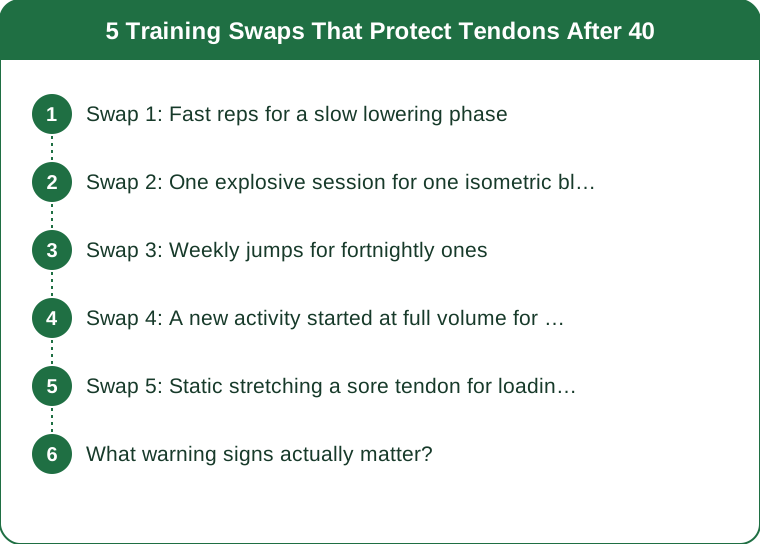
Swap 1: Fast reps for a slow lowering phase
Trade explosive tempo for a controlled three to four second lowering phase on your main lifts.
Tendons respond well to slow, heavy, controlled loading. The eccentric phase, where the muscle lengthens under load, is where tendon adaptation is most reliably stimulated, and it is the phase most people rush through on their way to the next rep.
A three-second lowering on a squat, a Romanian deadlift or a press adds significant time under tension without adding weight, which is exactly the trade a forty-plus tendon wants. Load stays the same, stimulus goes up, peak force stays controlled.
This also improves technique quality, because rushing the lowering phase is where most form breakdown originates.
Start with your two main lifts of the session. You do not need to slow everything down.
Swap 2: One explosive session for one isometric block
Replace some jumping, sprinting or ballistic work with heavy isometric holds.
Isometrics, holding a position under load without movement, have good evidence for tendon health and for reducing tendon pain. They load the tissue substantially while producing very low peak stress rates, which is precisely the profile that suits a tendon that is already grumbling.
Practical version: four to five holds of 30 to 45 seconds at a challenging but sustainable load, with a couple of minutes between. A wall sit variant for the knee, a mid-range calf raise hold for the Achilles, a static hang or a held row position for the elbow.
This is not a permanent replacement for explosive work, which remains valuable for power and bone. It is a way of keeping tendon loading high during periods when explosive volume needs to come down.
Two sessions a week is enough to feel a difference within three to four weeks.
Swap 3: Weekly jumps for fortnightly ones
Change your load progression from weekly increases to increases every two weeks, and hold the new load longer.
This is the single highest-value change on the list, and it is the one people resist most.
Muscle can often handle a weekly increase. Tendon adapts over a longer timescale, with collagen turnover measured in months rather than weeks. When you add load weekly, your muscles keep pace and your tendons fall progressively behind, and the gap eventually shows up as pain.
Progressing every second week costs you very little over a year and reduces the accumulation of that mismatch substantially. In practice most masters lifters find they progress further over twelve months this way, because they are not losing six weeks to a flare-up every spring.
A useful rule: no more than about a 10 percent increase in weekly training load, whether that load comes from weight, volume or running distance.

Swap 4: A new activity started at full volume for a four-week ramp
When you add anything new, start at roughly a third of the volume you think you can handle and build over four weeks.
Tendon problems cluster around new activities: a new class, a new sport, a return after a break, a change of shoes, a switch from bike to run. The tissue has no accumulated tolerance for the specific loading pattern, regardless of how fit you are generally.
This is why a strong lifter can get Achilles pain from three weeks of pickleball, and why a runner can develop elbow pain from a month of rowing. General fitness does not transfer to specific tendon tolerance.
The four-week ramp is unglamorous and it works. Week one at a third, week two at a half, week three at three quarters, week four at full. The main cost is patience, and the alternative cost is usually eight weeks off.
Apply it particularly to anything with high repetition counts, since tendon load is cumulative.
Swap 5: Static stretching a sore tendon for loading it
When a tendon is irritable, replace passive stretching with progressive loading.
The instinct with a sore tendon is to stretch it. For most tendinopathies this is counterproductive, since stretching compresses the tendon against underlying bone at the insertion, which is often exactly where the problem is.
Tendons respond to load, not to length. The established approach for tendinopathy is progressive loading: isometrics first if it is painful, then slow heavy resistance work, building over weeks to months.
Gentle range of motion is fine. Aggressive end-range stretching of an angry insertional tendon usually makes it worse.
And the timeline is long. Tendinopathy typically takes three to six months of consistent loading to resolve properly, and the most common reason it does not resolve is people stopping when the pain improves at week four.
If pain is severe, worsening, or accompanied by sudden loss of function, that is a matter for a physiotherapist or doctor rather than a programme adjustment.
This is general information, not medical advice.
What warning signs actually matter?
Tendons give clearer warnings than most tissues, and the pattern is recognisable:
- Morning stiffness in a specific tendon that eases with movement. This is the classic early tendinopathy signal, and it is the one worth acting on immediately.
- Pain that warms up and disappears during a session, then returns worse the next day. Very characteristic, and very easy to dismiss because the session felt fine.
- Localised tenderness you can point at with one finger.
- Pain that started within a few weeks of a change in volume, footwear, surface or activity.
What should I do at the first sign?
Reduce volume by about half rather than stopping, start isometrics, and hold the reduced load for two weeks. Early intervention takes weeks. Ignoring it takes months.
Does this mean I should train less after 40?
No. Masters athletes need the training more, not less. The change is in the rate of progression and the tempo, not the amount.
How long do these swaps take to show a benefit?
Three to four weeks for symptom improvement, three to six months for genuine tendon adaptation.
This is general information, not medical advice. Persistent or severe tendon pain deserves professional assessment.
TL;DR:
- Muscle adapts in weeks, tendon in months, and the mismatch is what injures masters athletes.
- Swap fast reps for a three to four second lowering phase on main lifts.
- Add isometric holds, progress load every two weeks, and ramp any new activity over four weeks.
- Load an irritable tendon, do not stretch it, and expect three to six months for full resolution.
- Morning stiffness in one tendon is the early warning worth acting on immediately.
None of these swaps reduce how much you train. They change how fast you change, which is the variable tendons actually care about. Get the rate right and the training stops being interrupted every few months by something that felt fine right up until it did not.
Keep Reading
This article is for general informational and styling purposes only. Fit, sizing, and product availability may vary.