5 Cold Morning Training Adjustments Worth Making After 40
Quick Answer: Cold tissue is stiffer, less elastic, and slower to reach working temperature — and after 40 that gap widens, because tendon elasticity and circulation both decline. The five adjustments that matter most are a longer general warm-up, an earlier first meal, a slower first interval, more layers kept on for longer, and moving mobility work to the end of the session. Together they add about ten minutes and prevent most autumn injuries.
The first cold morning always catches people out. Same session, same route, same warm-up length — and everything feels tight, heavy, and strangely difficult.
After 40 this is not a feeling. It is a measurable change in how long your tissue takes to become ready, and the fix is a schedule change rather than a toughness problem.

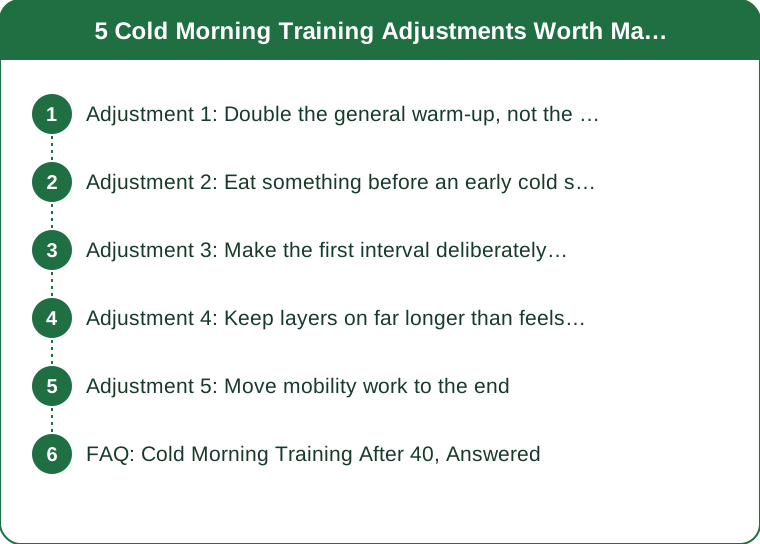
Adjustment 1: Double the general warm-up, not the specific one
The part that needs to grow is the boring bit at the start — the five minutes of easy movement that raise core temperature before anything specific happens.
Cold muscle is measurably stiffer, and both tendon and muscle become more compliant as temperature rises. After 40, tendons have lower baseline elasticity and take longer to reach working properties, so the same ambient temperature represents a bigger handicap than it did at 25.
In summer, five minutes of easy movement is often enough. On a 6-degree morning, eight to twelve minutes is the honest number, and it should be genuinely easy — the objective is temperature, not stimulus.
The specific warm-up that follows — the build-up sets, the drills, the rehearsal of what you are about to do — stays roughly the same length. People tend to do the opposite, adding more drills while keeping the general portion short, which leaves them doing precise movements on cold tissue. That is the sequence that produces the classic early-autumn strain.
Adjustment 2: Eat something before an early cold session
Fasted training that worked all summer becomes noticeably harder in the cold, and there is a physiological reason.
Maintaining core temperature in cold air costs energy, and that cost is drawn from the same limited pool that fuels your session. Shivering alone can multiply resting energy expenditure several-fold, and even sub-shivering thermogenesis is a real draw.
After 40, glycogen storage and the speed of mobilising it both trend downward slightly, which means a smaller buffer to absorb the extra cost.
Something small, 30 to 45 minutes before, is enough — a banana, a piece of toast, a small yoghurt. Not a meal. The purpose is to keep blood glucose stable through a warm-up that now takes twice as long, not to fuel the whole session.
The effect is most obvious in the first fifteen minutes, which is exactly the window where cold-morning sessions most often fall apart.
Adjustment 3: Make the first interval deliberately slower
Whatever the session is, the first hard effort should be at about 80 percent of the target, no matter how good you feel.
Cold air makes early efforts feel easier than they are. Your perceived exertion is lower because you are not overheating, so you set off at a pace that is genuinely too fast for tissue that is not yet at temperature. The mismatch between how it feels and how ready you are is the single biggest injury driver in autumn.
After 40, the consequences land in connective tissue rather than muscle — calf strains, Achilles complaints, hamstring niggles — and those take weeks to resolve rather than days.
The rule: first interval at 80 percent, second at 90, third at full. You lose almost nothing from the session’s total quality, and you remove most of the risk. If you are lifting rather than running, the equivalent is an extra ramp-up set before your working weight.

Adjustment 4: Keep layers on far longer than feels necessary
Overdress for the warm-up, strip during the session, and put a layer back on the moment you stop.
The mistake is dressing for how you will feel in twenty minutes rather than for now. Starting cold means the warm-up spends its first several minutes just returning you to baseline instead of building on it.
Start with one more layer than you think you need, and remove it during the first hard effort rather than before it. A layer that is easy to take off mid-session — a zip rather than a pullover — makes this practical.
The post-session layer matters more after 40. Recovery processes are temperature-sensitive, and standing around damp in cold air after a session is genuinely counterproductive as well as unpleasant. A dry top and a warm layer within five minutes of finishing is a small logistical change with a disproportionate effect on how you feel that afternoon and the next morning.
Hands and ears deserve a mention. Peripheral circulation declines with age, and cold hands make gripping a bar or a pole meaningfully harder well before the rest of you notices anything.
Adjustment 5: Move mobility work to the end
Static stretching on cold tissue does very little and may reduce output. The same work after a session, when tissue is warm, does considerably more.
Long static holds before training temporarily reduce force production and do not reliably reduce injury risk. That is true at any age. What changes after 40 is that cold tissue reaches a genuinely stretchable state much later, so a pre-session stretch is even less productive than it used to be.
Before: dynamic movement only. Leg swings, arm circles, walking lunges, controlled rotations. Movement through range, not holds.
After: static holds, when everything is warm. This is when range of motion actually improves, and it is a better use of the same ten minutes.
The practical benefit of the swap is that mobility work stops competing with the session for time and motivation. Placed at the end, when you are warm and the hard part is done, it is far more likely to happen at all — and consistency is what drives range of motion, not any individual stretch.
FAQ: Cold Morning Training After 40, Answered
How cold does it need to be before this matters?
Around 10 degrees Celsius is where most people notice the change, and below 5 it is unmistakable. The bigger factor is often the change rather than the absolute temperature — the first cold week after a warm month catches people out more than midwinter does.
Is a warm shower before training a reasonable shortcut?
It helps a little with surface tissue and comfort, but it does not raise deep muscle temperature the way active movement does. Use it as an addition, not a substitute for the longer warm-up.
Should I train indoors instead through winter?
Not necessarily — outdoor training in cold weather is fine and many people prefer it. The adjustments here are what make it fine. If conditions are icy, though, fall risk becomes the dominant concern and indoors is the better call.
Do these adjustments cost much time?
About ten minutes in total, most of it in the extended general warm-up. Given that the alternative is a calf strain costing three to six weeks, it is among the better trades available.
TL;DR:
- Cold tissue is stiffer and slower to warm, and both effects are larger after 40 — the fix is scheduling, not toughness.
- Double the general warm-up to 8 to 12 minutes; keep the specific warm-up the same length.
- Eat something small beforehand, start the first hard effort at 80 percent, and keep layers on longer than feels necessary.
- Move static mobility work to the end of the session, when tissue is actually warm.
Pick the first two this week — the longer warm-up and the slower opening effort. They cover most of the risk between them, and they cost about ten minutes.
Keep Reading
This article is for general informational and styling purposes only. Fit, sizing, and product availability may vary.