5 Recovery Methods After 40, Ranked by What Actually Works
Quick Answer: Sleep and protein do more for recovery after 40 than every device and modality combined. Easy movement is third. Heat and compression are real but modest, and belong at the end of the list rather than the center of a routine.
The recovery industry sells the bottom of this list hardest, because you can’t put sleep in a box.
Here’s the honest order, with what each one actually buys you.
This is general information, not medical advice.

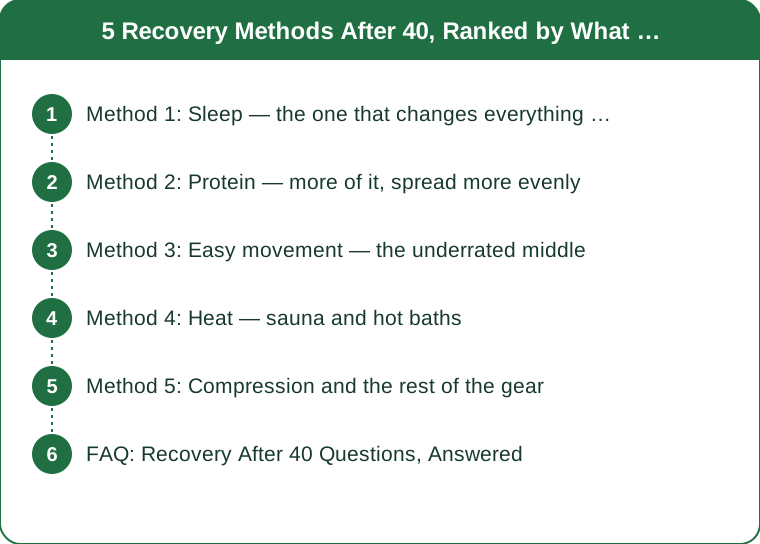
Method 1: Sleep — the one that changes everything else
Nothing else on this list comes close, and it isn’t a close call.
Most of your growth hormone release happens during deep sleep, and deep sleep is exactly what declines with age — often substantially between 30 and 60. That’s a large part of why recovery genuinely slows after 40, independent of training.
Short sleep also measurably impairs muscle protein synthesis, raises cortisol, and reduces glycogen replenishment. In studies restricting sleep to around 5 hours, strength and power outputs drop within days.
What to actually do: protect 7-9 hours, keep the wake time consistent even after a bad night, and get the bedroom under 67F — temperature drives deep sleep more than most people expect. If you take one thing from this list, take this one.
Effect size: very large. Nothing you buy substitutes for it.
Method 2: Protein — more of it, spread more evenly
After 40 you develop anabolic resistance: the same dose of protein triggers less muscle protein synthesis than it did at 25. You need more to get the same result.
The practical implication is a higher daily target — commonly 1.6-2.2 g per kg of bodyweight for people training seriously — and, importantly, better distribution. Roughly 30-40 g per meal across 3-4 meals outperforms the same total eaten mostly at dinner.
Leucine is the specific trigger, and older muscle needs more of it to cross the threshold. That’s why a 20 g serving that worked in your twenties may not clear the bar now.
What to actually do: hit a protein target at breakfast, which is the meal most people under-eat it at. Then keep the rest even.
Effect size: large. Second only to sleep, and the one most people can improve immediately.
Method 3: Easy movement — the underrated middle
Active recovery works through a mechanism that’s easy to describe: gentle movement increases blood flow to recovering tissue without adding meaningful training stress.
What counts is genuinely easy — a 20-40 minute walk, easy cycling, or light mobility work at a pace where you could hold a full conversation. If you’re breathing hard, it’s a training session wearing a recovery label, and it adds to the fatigue you’re trying to clear.
This matters more after 40 than before, because joint stiffness accumulates faster and total inactivity on rest days makes the next session worse.
What to actually do: put one easy walk on every rest day. Not a workout. A walk.
Effect size: moderate, and reliably positive. Cheap, low risk, and it also helps sleep — which loops back to method 1.

Method 4: Heat — sauna and hot baths
Heat exposure has better evidence than most recovery modalities, though the effect is smaller than the enthusiasm around it suggests.
Regular sauna use is associated with improved cardiovascular markers, and heat exposure post-training may support blood flow and perceived recovery. Hot baths reliably help many people fall asleep faster, which is arguably where most of the recovery benefit actually comes from.
The timing detail worth knowing: a hot bath 1-2 hours before bed works better than immediately before, because the subsequent drop in core temperature is what cues sleep onset.
What to actually do: if you enjoy it, 15-20 minutes, a few times a week, in the evening.
Effect size: small to moderate. Genuinely worthwhile, but it isn’t a substitute for the three above it.
Method 5: Compression and the rest of the gear
Compression garments, massage guns, and cold plunges all have some supporting evidence, and all of it is modest.
Compression appears to reduce perceived soreness and may slightly help with swelling. The effect on actual performance recovery is small.
Massage guns reduce perceived soreness and improve short-term range of motion. That’s a real benefit, and it’s mostly a comfort one.
Cold plunges reduce soreness but there’s reasonable evidence that regular cold immersion after strength training may blunt adaptation — the inflammation you’re suppressing is part of the signal to adapt. If you’re lifting to build muscle, this one has a genuine cost.
What to actually do: use them if you like them, after the first four are handled. Don’t let them displace sleep or protein.
Effect size: small. The gap between method 1 and method 5 is not a ranking detail — it’s the whole story.
FAQ: Recovery After 40 Questions, Answered
How much longer does recovery actually take after 40?
Less than the internet suggests for most sessions, but noticeably longer for high-intensity and eccentric-heavy work — often 24-48 hours more before full performance returns. Tendon and connective tissue lag furthest behind muscle.
Are rest days more important than they used to be?
The number of hard sessions you can absorb weekly usually drops, yes. But complete rest isn’t the answer — replacing one hard day with an easy day generally works better than removing the day entirely.
Do recovery supplements help?
Creatine has good evidence for strength and may help with recovery between sessions. Beyond that, the supplement recovery category is largely unimpressive. Money is better spent on food that hits your protein target.
TL;DR:
- Sleep is first by a wide margin — deep sleep drives growth hormone and declines with age.
- Protein second: 1.6-2.2 g/kg, spread as 30-40 g across 3-4 meals.
- Easy movement third — a genuine walk on rest days, not a disguised workout.
- Heat fourth, mostly via better sleep; compression and gadgets fifth and small.
- Cold plunges after lifting may blunt the adaptation you trained for.
The order matters more than any individual item. Most people after 40 are running a sophisticated method 5 routine on top of a broken method 1 — and wondering why recovery feels harder every year.
This is general information, not medical advice.
Keep Reading
This article is for general informational and styling purposes only. Fit, sizing, and product availability may vary.