5 Recovery Habits That Actually Matter More Than Soreness After 40
Quick Answer: After 40, recovery quality matters more than recovery duration alone — sleep consistency, protein timing, active recovery movement, joint-specific mobility work, and tracking readiness (not just soreness) are the five habits with the most evidence behind them.
Most people over 40 assume harder recovery means more rest days. In practice, the athletes who keep training consistently into their 40s and 50s tend to lean on a specific, repeatable set of habits rather than just adding downtime.

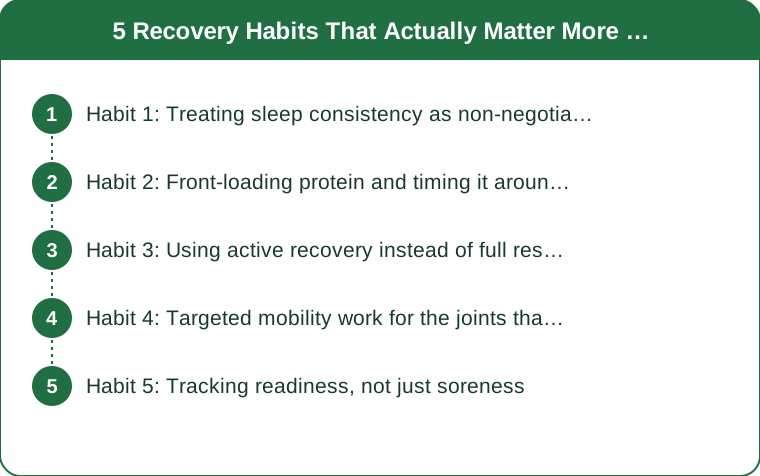
Habit 1: Treating sleep consistency as non-negotiable
Sleep is where the bulk of tissue repair and hormonal recovery actually happens, and after 40 the margin for error shrinks — a single rough night has a bigger visible impact on the next day’s training quality than it did a decade earlier. The habit that separates consistent masters athletes isn’t necessarily more total sleep, it’s a consistent sleep-wake schedule, even on weekends, since irregular timing disrupts the deeper recovery stages more than a slightly shorter but consistent night does.
A practical target: 7-9 hours, with a wind-down routine starting 30-45 minutes before the same bedtime most nights. Athletes who protect this schedule report noticeably better next-day training quality than those chasing an extra hour or two only after a hard session.
Habit 2: Front-loading protein and timing it around training
Muscle protein synthesis becomes measurably less efficient with age — a phenomenon sometimes called anabolic resistance — which means the same protein intake that worked at 25 may not be enough at 45 to support the same recovery. The practical fix is spreading protein intake across the day in 25-40 gram doses, rather than back-loading most of it at dinner, and prioritizing a protein-containing meal or snack within a couple hours of training.
This habit matters more with age specifically because the body’s response to a given protein dose blunts somewhat over time, so hitting an adequate total (commonly cited around 1.2-1.6g per kg of bodyweight for active older adults) and distributing it well compensates for that reduced efficiency.

Habit 3: Using active recovery instead of full rest days
Complete rest isn’t always the fastest route back to full capacity after 40 — light movement that increases blood flow without adding real training stress (an easy walk, gentle cycling, a slow swim) often leaves people feeling and performing better the next day than doing nothing at all. This isn’t about training through fatigue, it’s about avoiding the stiffness and reduced circulation that comes with total inactivity, which tends to compound with age.
A practical version: 20-30 minutes of easy-paced movement on a day between harder sessions, kept genuinely easy enough that it doesn’t add fatigue — the goal is circulation, not another workout.
Habit 4: Targeted mobility work for the joints that actually get tight
Rather than generic full-body stretching, the masters athletes who stay consistent tend to identify the 1-2 joints that reliably get tight or restricted for them specifically — often hips, shoulders, or ankles — and spend focused time there daily rather than spreading a few minutes thin across the whole body. This targeted approach produces a noticeably bigger return than a generic five-minute stretch routine touching everything superficially.
A reasonable target is 5-10 minutes daily on those specific problem areas, ideally after a light warm-up rather than cold, since tissue responds better to mobility work once it has some blood flow.
Habit 5: Tracking readiness, not just soreness
Soreness is a poor recovery indicator on its own — it’s delayed, inconsistent, and doesn’t always correlate with actual recovery status. Athletes who train consistently into their 40s and 50s often track something more objective instead: resting heart rate, sleep quality, or simply a consistent morning check-in on energy and motivation before deciding how hard to push that day’s session.
This doesn’t require expensive equipment — even a simple daily 1-10 self-rating of energy, tracked in a notebook or app, gives a more reliable signal over weeks than relying on whether muscles feel sore, since soreness often peaks a day or two after the actual recovery-limiting stress occurred.
TL;DR:
- Consistent sleep timing beats chasing extra hours only after hard sessions
- Spread protein in 25-40g doses through the day to offset age-related anabolic resistance
- Easy active recovery often beats full rest for reducing next-day stiffness
- Track readiness (heart rate, energy, sleep) rather than relying on soreness alone
The fifth habit is the one most people skip entirely — and it’s usually the one that prevents overtraining before it becomes an injury.
Keep Reading
This article is for general informational and styling purposes only. Fit, sizing, and product availability may vary.