5 Recovery Mistakes Masters Athletes Make Without Realizing It
Quick Answer: The most common recovery mistakes for masters athletes are treating recovery time the same as in their 20s, under-prioritizing sleep, skipping deload weeks, ignoring joint-specific warm-up needs, and under-fueling protein intake — all fixable with small, deliberate adjustments.
Masters athletes often train smart but recover the same way they did decades ago. Here are 5 specific mistakes worth catching before they compound.

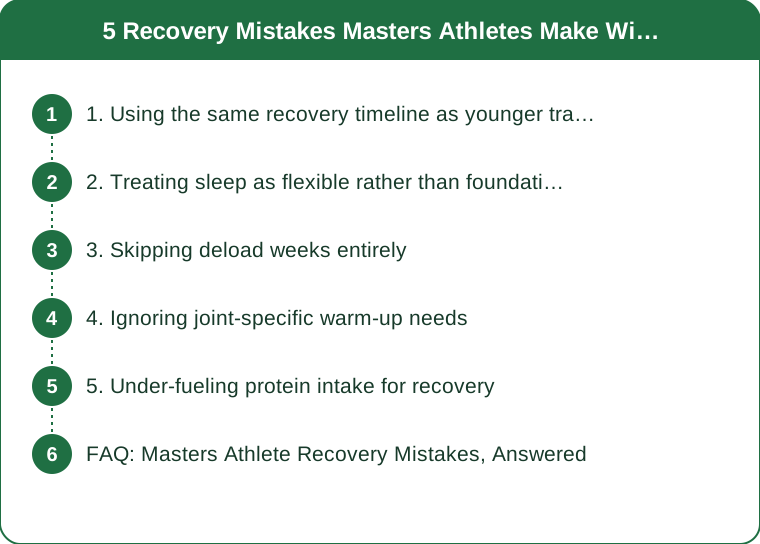
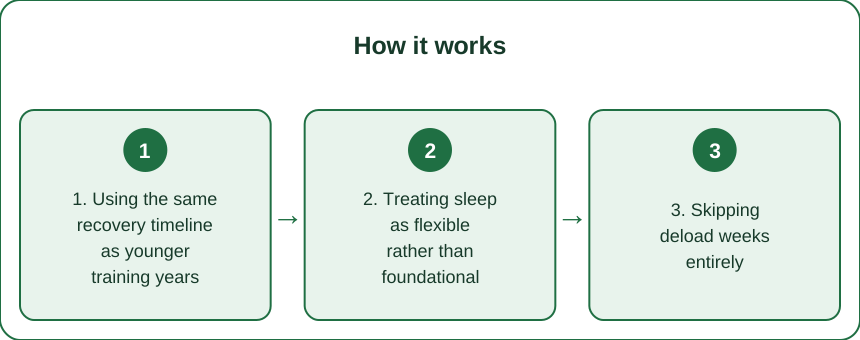
1. Using the same recovery timeline as younger training years
Recovery capacity genuinely slows with age, meaning the 48-hour turnaround between hard sessions that worked at 25 may need to stretch to 72+ hours to avoid accumulating fatigue that shows up as plateaus or injury weeks later.
2. Treating sleep as flexible rather than foundational
Sleep quality has an outsized role in recovery and hormone regulation as we age, yet it’s often the first thing sacrificed for an early workout. Masters athletes benefit disproportionately from protecting sleep compared to younger training peers.
3. Skipping deload weeks entirely
Deload weeks — planned reduced-volume periods — become more important, not less, with age, since the accumulated fatigue that deloads address builds up faster and takes longer to resolve on its own without deliberate lower-intensity weeks.

4. Ignoring joint-specific warm-up needs
Joints generally need more deliberate, longer warm-up time with age due to naturally reduced synovial fluid production and connective tissue elasticity — rushing straight into working sets is a more common injury trigger for masters athletes than for younger lifters.
5. Under-fueling protein intake for recovery
Protein needs for muscle recovery may actually increase with age due to anabolic resistance (reduced muscle protein synthesis response to a given protein dose), meaning intake levels that were sufficient in your 20s and 30s may now fall short.
FAQ: Masters Athlete Recovery Mistakes, Answered
How much extra recovery time should masters athletes actually plan for?
A rough guide is 25-50% more recovery time between hard sessions on the same muscle groups compared to younger training years, adjusted individually.
Is it too late to fix these mistakes if I’ve been training this way for years?
No — adjusting recovery habits produces noticeable improvement in training quality and injury reduction fairly quickly, often within weeks.
Does this mean masters athletes should train less overall?
Not necessarily less total training, but more deliberately structured recovery within the same overall training plan.
TL;DR:
- Recovery timelines genuinely need to extend with age, not stay the same as younger years
- Sleep and joint-specific warm-up time deserve more deliberate priority
- Deload weeks become more important, not optional, as recovery capacity changes
- Protein needs may increase with age due to anabolic resistance in muscle recovery
Keep Reading
This article is for general informational and styling purposes only. Fit, sizing, and product availability may vary.