5 Recovery Habits Worth Photographing to Actually Track Progress After 40
Quick Answer: Photographing sleep environment setup, hydration habits, stretching routines, meal composition, and visible swelling or bruising creates a visual record that reveals recovery patterns memory alone tends to miss, especially for masters athletes managing slower recovery.
Recovery after 40 depends on details easy to forget by the next week — a simple photo habit turns vague impressions into an actual trackable record.

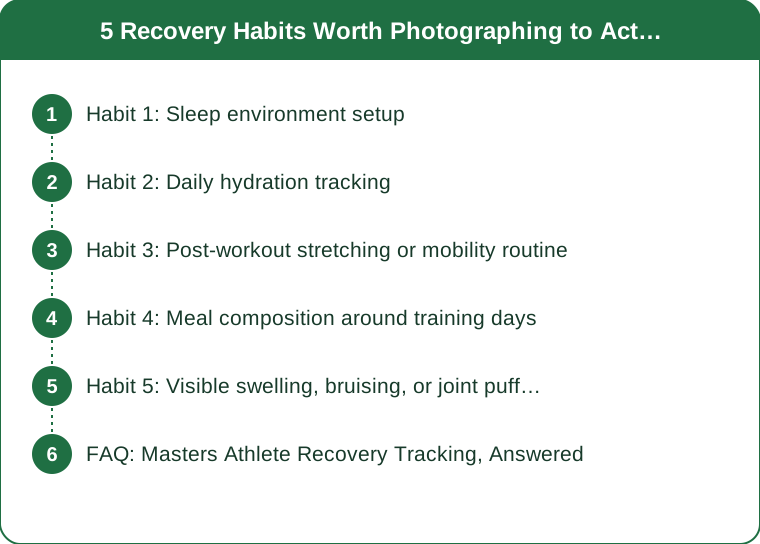
Habit 1: Sleep environment setup
A quick photo of the bedroom setup — lighting, temperature indicator, phone placement — on nights with notably good or bad sleep helps identify environmental patterns affecting recovery that are easy to overlook in the moment.
Habit 2: Daily hydration tracking
Photographing a water bottle or hydration tracker at set points in the day builds an honest visual record of intake, which is often less accurate when estimated from memory alone, particularly on busy training days.
Habit 3: Post-workout stretching or mobility routine
A quick photo or short video of a stretching or mobility session helps confirm whether it actually happened consistently, since recovery habits are easy to believe you are doing more often than you actually are.

Habit 4: Meal composition around training days
Photographing meals on hard training days versus rest days over a few weeks reveals whether protein and overall nutrition intake is actually adequate to support recovery, a pattern that is hard to judge accurately from memory.
Habit 5: Visible swelling, bruising, or joint puffiness
Photographing any visible joint swelling or bruising at the same angle over several days tracks whether recovery is progressing as expected or whether something needs more attention than initially assumed.
FAQ: Masters Athlete Recovery Tracking, Answered
Does this replace more formal recovery tracking tools?
No — it complements tools like heart rate variability trackers or training logs by adding a visual layer that is easy to review and compare over time.
How often should these photos actually be taken?
A quick daily habit around training days is usually enough to build a useful pattern within two to three weeks without becoming burdensome.
Is this worth doing for someone under 40 too?
Yes — the specific value is higher for masters athletes managing slower recovery, but the tracking principle helps at any age.
TL;DR:
- A simple photo habit turns vague recovery impressions into an actual trackable record
- Sleep setup, hydration, stretching, meals, and visible swelling are all worth documenting
- This complements rather than replaces formal recovery tracking tools
- A daily habit around training days builds a useful pattern within a few weeks
For masters athletes, a few seconds of photo tracking often reveals recovery patterns that memory alone consistently misses.
Keep Reading
This article is for general informational and styling purposes only. Fit, sizing, and product availability may vary.