5 Recovery Signals Worth Tracking After 40 (Instead of Just Counting Rest Days)
Quick Answer: After 40, recovery capacity varies enough day to day that a fixed rest-day schedule undersells or oversells how ready your body actually is — tracking grip strength, resting heart rate, sleep quality, morning mood, and tendon soreness gives a far more accurate readiness picture than simply counting days off.
At 25, a rest day was a rest day — recovery mostly happened on schedule. After 40, recovery capacity swings more from week to week, which means the calendar stops being a reliable guide. These five signals do a better job.

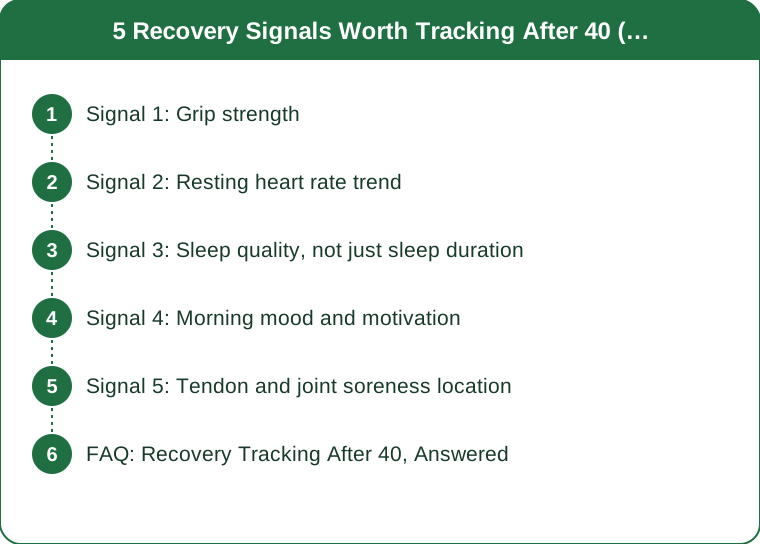
Signal 1: Grip strength
A simple dead hang or hand-dynamometer check first thing in the morning is one of the most sensitive early indicators of systemic fatigue — grip strength tends to dip before other, more obvious signs of undertraining show up, making it a useful early-warning signal specifically for masters athletes managing recovery more carefully than they did in their 20s.
Signal 2: Resting heart rate trend
A resting heart rate 5-8 beats above your typical baseline, tracked over several mornings rather than a single day, reliably signals incomplete recovery from accumulated training stress. After 40, this signal becomes more useful because recovery is less automatic and more worth actively monitoring.
Signal 3: Sleep quality, not just sleep duration
Eight hours of fragmented, restless sleep doesn’t provide the same recovery as seven hours of consolidated deep sleep — after 40, sleep architecture naturally shifts toward lighter, more fragmented patterns, making sleep quality (not just total hours) a more honest recovery indicator than it was at 25.

Signal 4: Morning mood and motivation
A consistent dip in motivation to train, especially for activities you normally enjoy, often precedes physical signs of overreaching by several days. This signal gets dismissed as ‘just not feeling it,’ but tracked over a week it’s a genuinely useful early data point for masters athletes.
Signal 5: Tendon and joint soreness location
After 40, tendons recover measurably slower than muscle tissue does, so soreness that’s specifically tendon-based (a nagging ache at a joint, not general muscle fatigue) needs longer recovery windows than muscle soreness alone would suggest — tracking where soreness sits, not just how much, changes how you should plan the next session.
FAQ: Recovery Tracking After 40, Answered
Do you need special equipment to track these five signals?
No — a basic fitness watch covers resting heart rate and sleep, and grip strength, mood, and soreness location can all be checked with no equipment at all, just a consistent daily habit of noting them.
How many signals need to be ‘off’ before adjusting training?
Two or more consistently off over 2-3 days is a reasonable threshold for scaling back intensity — one isolated off-day rarely means much on its own.
Does tracking replace the two-day recovery rule masters athletes often use?
It complements it — the two-day rule is a helpful default, but these five signals let you adjust that default up or down based on what your body is actually showing that week.
TL;DR:
- Grip strength and resting heart rate are early, sensitive signals of accumulated fatigue after 40
- Sleep quality matters more than total hours once sleep architecture naturally fragments with age
- Motivation dips and tendon-specific soreness both deserve attention as real recovery signals, not excuses
- Two or more signals off for several days is a better cue to scale back than a fixed rest-day calendar
Start tracking these five signals this week — after 40, they’ll tell you more about actual readiness than any generic rest schedule.
Keep Reading
This article is for general informational and styling purposes only. Fit, sizing, and product availability may vary.