5 Signs Your Recovery Routine Needs to Change After 40
A photo essay showing 5 visual and physical signs it’s time to update a recovery routine after 40, with real training context for each.

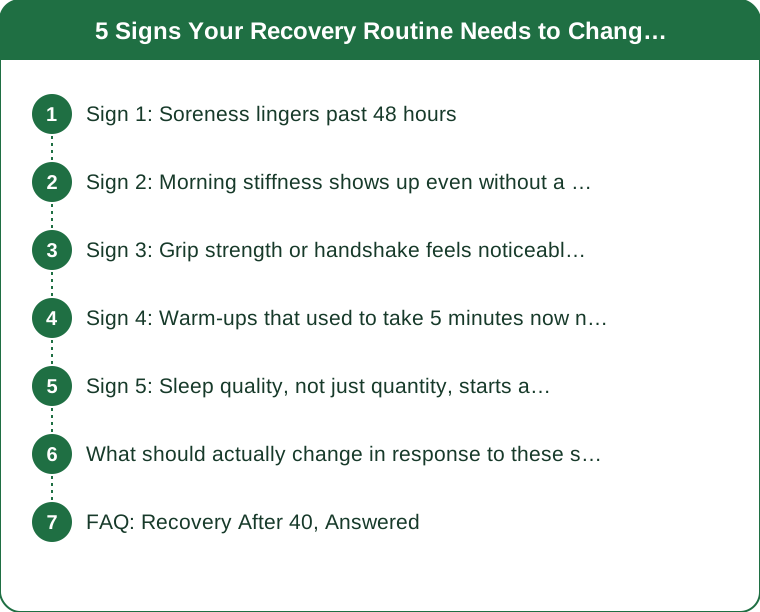
Sign 1: Soreness lingers past 48 hours
In your 20s, a hard session might leave you sore for a day, maybe two. After 40, the same session can leave soreness lingering 3-4 days if recovery habits haven’t adjusted — this is a well-documented shift in recovery timeline with age, tied to slower muscle protein synthesis rates. A phone photo of your training log showing back-to-back hard days with no improvement is a useful visual cue that spacing needs to change.
Sign 2: Morning stiffness shows up even without a hard workout
Waking up stiff after an easy day, not just a heavy one, is a signal that baseline recovery capacity has shifted, not that any single workout was too much. A quick video of your first few steps out of bed, watched back a month later, often reveals gradual improvement or decline more honestly than how you feel you’re moving.
Sign 3: Grip strength or handshake feels noticeably weaker
Grip strength is one of the more studied early markers of age-related strength decline, and it often drops before other more obvious performance markers do. A simple monthly photo or note of a grip dynamometer reading, if you have access to one, or even just noting how confidently you can open a stubborn jar, tracks something meaningful over time.

Sign 4: Warm-ups that used to take 5 minutes now need 15
Needing a longer warm-up isn’t a decline to be embarrassed about — it’s useful data that joints and connective tissue need more preparation time before load than they did a decade earlier. Tracking warm-up duration in a training log, alongside how a session actually feels, helps distinguish ‘I’m rushing’ from ‘my body genuinely needs more ramp-up now.‘
Sign 5: Sleep quality, not just quantity, starts affecting next-day performance
Many masters athletes notice that sleep quality metrics (if tracked via a wearable) correlate more tightly with next-day performance after 40 than they did in earlier decades — a bad night now visibly costs more than it used to. A simple screenshot comparison of a wearable’s sleep score against how a workout felt the next day, kept over a few weeks, often makes this connection obvious in a way daily impressions miss.
What should actually change in response to these signs?
More recovery days between hard efforts, longer warm-ups, and prioritizing sleep consistency over sleep hacks are the three most evidence-supported adjustments for masters athletes. This doesn’t mean training less overall — many masters athletes maintain high performance by restructuring the recovery-to-load ratio, not by simply doing less.
FAQ: Recovery After 40, Answered
Do masters athletes need more rest days than younger athletes?
Generally yes — most masters training guidance suggests one additional recovery day per week compared to a similar program in your 20s or 30s.
Does taking longer to recover mean you’re losing fitness?
Not inherently — it reflects normal physiological changes in recovery capacity, and adjusting the program around it, rather than ignoring it, is what protects long-term performance and injury prevention.
Is it worth getting grip strength tested formally after 40?
It’s a reasonable, low-cost marker to track if accessible, given how strongly it correlates with broader strength and functional aging trends in the research.
TL;DR:
- Lingering soreness, baseline stiffness, weaker grip, longer warm-up needs, and sleep-performance links are 5 real signs recovery has shifted after 40
- These are normal physiological changes, not signs of decline to be alarmed by
- The fix is usually more recovery days and longer warm-ups, not less training overall
- Track them with simple photos, notes, or a wearable — patterns show up clearer than daily impressions
This is general information, not medical advice — persistent pain or sudden strength loss warrants a professional evaluation rather than a training-log fix.
Keep Reading
This article is for general informational and styling purposes only. Fit, sizing, and product availability may vary.