5 Sleep Habits That Change Your Training Results After 40
Quick Answer: Deep sleep declines with age and is when most growth hormone release and tissue repair occurs, which means the recovery gap masters athletes notice is partly a sleep gap. Five habits do most of the work - a consistent wake time, a cool dark room, moving hard sessions and alcohol away from bedtime, deliberate morning light, and treating the pre-sleep hour as part of training. None require equipment, and the effects are usually visible within two to three weeks.
You have accepted that recovery takes longer now. It is worth checking how much of that is your training age and how much is the four times you woke up last night.

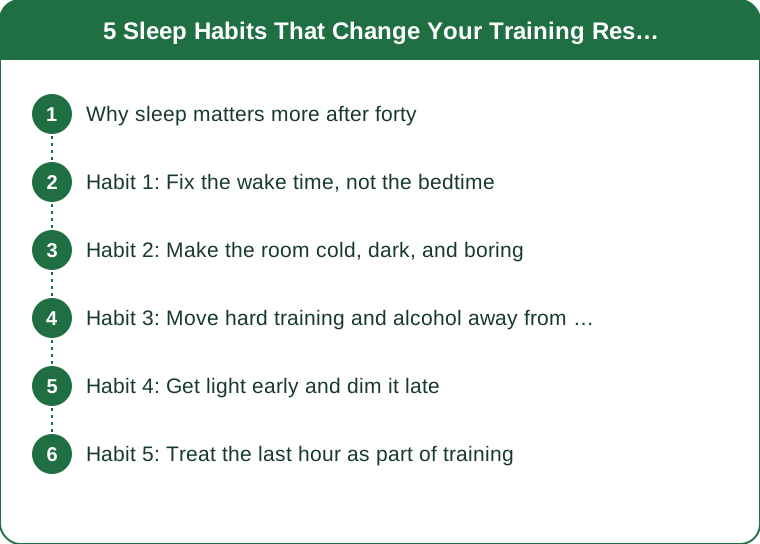
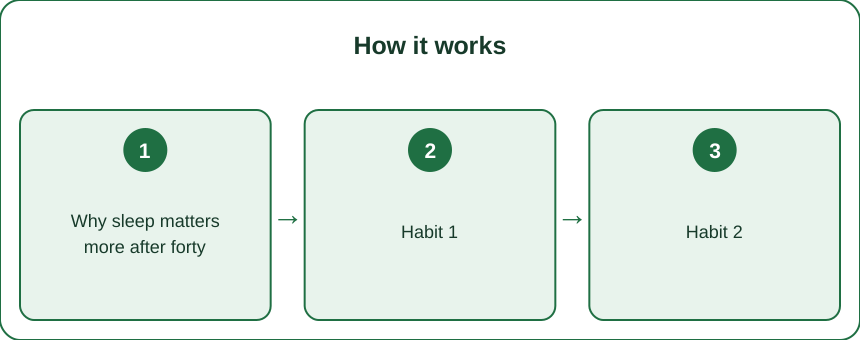
Why sleep matters more after forty
The change is specific rather than general.
Deep sleep declines with age. Slow-wave sleep - the deepest stage - decreases progressively from young adulthood onward, and by the forties most people get substantially less of it than they did at twenty-five.
Most growth hormone is released during deep sleep. That pulse is central to tissue repair and adaptation, so less deep sleep means slower recovery from the same training load.
Sleep becomes more fragmented. More brief awakenings, lighter sleep overall, and greater sensitivity to noise, temperature, and light. Total time in bed can look identical while the quality has changed considerably.
Tendon and connective tissue recovery is slower anyway after forty. Poor sleep compounds an existing change rather than causing it, which is why the effect feels larger than it did at thirty.
And the compensations available at twenty-five are gone. Younger athletes get away with poor sleep for a surprisingly long time. That buffer narrows, which is why the same habits produce different outcomes at different ages.
The encouraging part: sleep quality is more modifiable than age. The five habits below address the components that actually change with age, rather than generic advice to sleep more.
Habit 1: Fix the wake time, not the bedtime
This is the highest-value change and the one most people get backwards.
A consistent wake time anchors the whole system. Your circadian rhythm is set primarily by when light hits your eyes in the morning, not by when you go to bed. Fixing the wake time stabilises everything downstream, including when you naturally become sleepy.
Bedtime then sorts itself out. With a fixed wake time and adequate daytime activity, sleep pressure builds predictably and bedtime becomes easier rather than something you have to enforce.
Weekend consistency matters more after forty. A two-hour weekend lie-in produces a shift comparable to a small time-zone change, and the recovery from it is slower than it used to be. Keeping within an hour of your weekday wake time avoids most of it.
Do not chase lost sleep with a later alarm. After a bad night, keeping the wake time and going to bed slightly earlier the following evening restores the pattern faster than sleeping in.
Practical version: pick a wake time you can hold seven days a week, set it, and change nothing else for two weeks before judging.
Habit 2: Make the room cold, dark, and boring
Environmental sensitivity increases with age, so the room matters more than it used to.
Core temperature needs to drop for sleep to initiate. A cool room - somewhere around 16 to 19C for most people - supports that drop. This is one of the most consistently supported environmental factors, and it becomes noticeably more important in a late-summer bedroom.
A warm room fragments sleep specifically. Not just falling asleep - staying asleep. Much of the summer sleep deterioration people report is temperature rather than daylight.
Darkness matters more with age because sleep is lighter. Blackout curtains or a decent eye mask address the early summer sunrise, which otherwise pulls you out of the lightest sleep of the night at 5am.
Noise sensitivity increases too. Earplugs or a fan for white noise handle the brief awakenings that you may not even remember but which fragment the sleep architecture.
And a fan does double duty in August. Cooling and consistent background noise from the same device, which is why it is the most useful single item in a summer bedroom.
Habit 3: Move hard training and alcohol away from bedtime
Two separate inputs, both acting on the same window.
Hard training raises core temperature and sympathetic activation for hours. Finishing a demanding session within about three hours of bed makes it harder to fall asleep and reduces deep sleep once you do. Easy sessions have little effect and can help.
This is a genuine constraint for people who can only train in the evening. If 8pm is your only option, keep evening sessions at moderate intensity where possible and put the hardest work on days you can train earlier.
Alcohol is the single most disruptive input to sleep quality. It shortens the time to fall asleep and substantially suppresses deep sleep and REM in the second half of the night. The sedation is not sleep quality, and the effect is larger after forty than it was earlier.
Two drinks is enough to see it. Anyone tracking sleep with a wearable can see the effect clearly, and it is generally more dramatic than people expect.
A three-hour buffer before bed for both covers most of it, and moving alcohol to earlier in the evening reduces the impact meaningfully even without reducing the amount.
Habit 4: Get light early and dim it late
The strongest lever on circadian timing, and it is free.
Morning daylight sets the clock. Ten to twenty minutes of outdoor light within an hour of waking is the strongest signal available for anchoring the rhythm, and it is more effective than any indoor lighting.
Outdoor light is orders of magnitude brighter than indoor. Even an overcast morning provides far more light intensity than a well-lit room, which is why standing outside briefly beats sitting by a window.
Older eyes transmit less light. The lens yellows and the pupil admits less light with age, which means the same exposure produces a weaker circadian signal than it did at twenty-five. More light, earlier, compensates.
Dim the evening deliberately. Reducing overhead lighting in the last hour supports melatonin release. The specific worry about screens is smaller than the general effect of a brightly lit room.
Combine it with something you already do. Morning coffee outside, or the first ten minutes of a dog walk, requires no new time in the day - which is what makes it stick.
And expect two weeks before the pattern shifts. Circadian changes take time, and this one is frequently abandoned before it works.
Habit 5: Treat the last hour as part of training
The pre-sleep hour is where most of the practical failures happen.
Decide when the day ends and hold it. The most common pattern after forty is not difficulty sleeping but continually pushing bedtime later because the evening is the only unclaimed time. That is a scheduling problem rather than a sleep problem.
Front-load the evening. Admin, planning, and anything mentally demanding done earlier means the last hour can actually be a wind-down rather than the busiest part of the day.
Keep the wind-down consistent and dull. The same sequence each night becomes a signal in itself, and it works better when it is unstimulating rather than enjoyable enough to extend.
Write down tomorrow before you get into bed. Two minutes of getting the list out of your head reduces the lying-awake-planning pattern, which is one of the more common complaints in this age group.
Count sleep as training time, because it is. Masters athletes who protect sleep the way they protect their sessions consistently recover better, and treating it as optional is the most common reason a sensible programme underdelivers.
And track it for four weeks before drawing conclusions. Sleep varies enormously night to night, and the trend across a month tells you what a single week cannot.
This is general information, not medical advice. Persistent insomnia, loud snoring, or daytime sleepiness despite adequate time in bed should be discussed with a doctor - sleep apnoea becomes more common with age and is very treatable.
TL;DR:
- Deep sleep declines with age, and that is when most tissue repair happens - part of slower recovery is a sleep gap.
- Fix the wake time first, seven days a week, and let bedtime follow.
- Cool, dark, quiet room - environmental sensitivity increases with age, and a fan handles two problems at once.
- Keep hard training and alcohol at least three hours from bed.
- Get outdoor light within an hour of waking, dim the evening, and protect the last hour.
Recovery after forty is genuinely slower. It is also frequently worse than it needs to be, and four of the five reasons are in your bedroom.
Keep Reading
This article is for general informational and styling purposes only. Fit, sizing, and product availability may vary.