5 Strength Moves Worth Prioritizing After 40
Quick Answer: Trap bar deadlifts, split squats, farmer’s carries, rows, and controlled push-ups deliver the highest return for strength, joint health, and daily function after 40 — prioritize these over isolation work when your training time is limited.
You don’t need 12 exercises in a session to make real progress after 40. These five cover almost everything that actually matters.
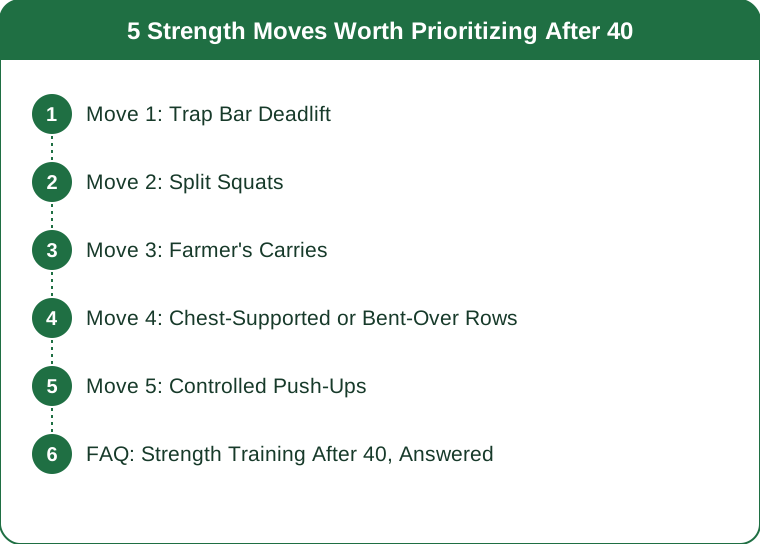
Move 1: Trap Bar Deadlift
The trap bar puts the load directly under your center of gravity instead of in front of it, which reduces lower back shear stress compared to a conventional barbell deadlift. It trains the same hip-hinge pattern you use picking anything heavy off the ground, making it one of the most transferable strength movements for daily life.
Move 2: Split Squats
Single-leg work like the split squat directly addresses the strength asymmetries that develop with age and builds the balance and stability that bilateral squats can mask. It’s also far more joint-friendly on the knees for most people than a heavy back squat, while still building serious quad and glute strength.
Move 3: Farmer’s Carries
Simply walking while holding heavy weight builds grip strength, core stability, and postural endurance simultaneously — and grip strength specifically is one of the strongest predictors of healthy aging in longevity research. It’s also one of the lowest-skill, lowest-injury-risk exercises on this list.

Move 4: Chest-Supported or Bent-Over Rows
Most people accumulate years of pressing (bench, push-ups, overhead) and comparatively little pulling, which creates shoulder posture imbalances that get more noticeable with age. Rows directly counter this, strengthening the upper back muscles that keep shoulders healthy and posture upright.
Move 5: Controlled Push-Ups
A slow, full-range push-up trains pressing strength, core stability, and shoulder health in one movement without loading the spine the way a bench press does. The controlled tempo — a 2-3 second lowering phase — matters more than speed for building real strength safely.
FAQ: Strength Training After 40, Answered
How many days a week should these five moves be trained?
Two to three full-body sessions per week, rotating through all five movements, is enough to build meaningful strength without excessive recovery demand.
Do you need to lift heavy to get the benefit from these moves?
Yes, eventually — bodyweight versions are a fine starting point, but progressing toward genuinely challenging loads over months is what drives strength and bone density benefits, not just going through the motions.
Should you warm up differently for these compared to your 20s or 30s?
Yes — a longer, more thorough warm-up (8-10 minutes) that includes the specific movement pattern at light load prepares joints and tissues better than the quick warm-ups that worked at a younger age.
TL;DR:
- Trap bar deadlifts train the hip hinge with less spinal stress
- Split squats fix asymmetries that bilateral squats hide
- Farmer’s carries build grip strength, a key longevity marker
- Rows and controlled push-ups balance out decades of pressing-heavy training
If your training time is limited after 40, these five moves cover strength, joints, posture, and grip — the areas that matter most for staying capable long-term.
Keep Reading
This article is for general informational and styling purposes only. Fit, sizing, and product availability may vary.