5 Training Adjustments That Matter Most After Fifty
Quick Answer: The five adjustments that matter most after fifty are: longer warm-ups, more recovery days between hard sessions, prioritising power as well as strength, higher protein intake, and adding dedicated balance work. Notably, reducing intensity is not on the list — heavy training remains both safe and important. What changes is the recovery around it and the specific qualities you deliberately protect.
The advice usually given is to take it easier. That is mostly wrong, and following it accelerates exactly what you are trying to avoid.
Here are the five changes that actually matter, in order.

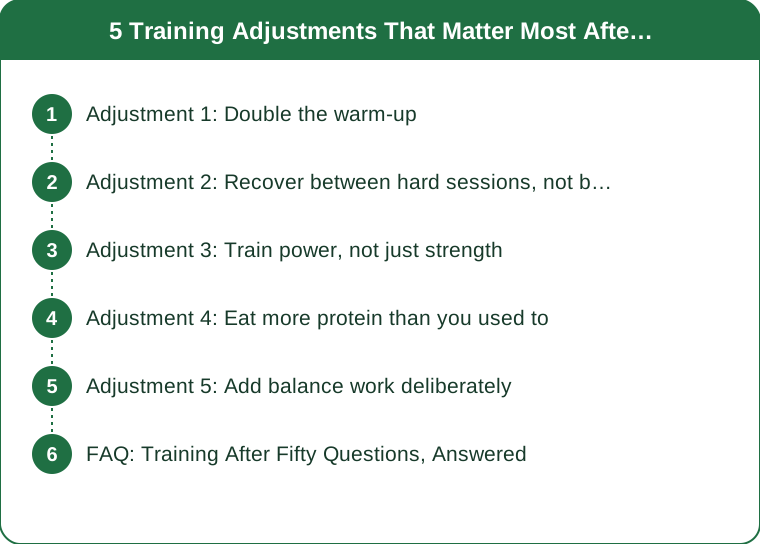
Adjustment 1: Double the warm-up
The single most noticeable change, and the one people resist longest.
What changes physiologically. Synovial fluid viscosity, tissue elasticity and neuromuscular readiness all take longer to reach working condition. Tendons in particular are slower to respond than muscle.
The practical version. Ten to fifteen minutes rather than five. Five minutes of general aerobic work to raise temperature, then movement-specific preparation, then progressively loaded warm-up sets.
Add more warm-up sets, not more stretching. Three or four ramping sets before your working weight, rather than one. This is where the neuromuscular preparation actually happens.
The tell that it worked. Your first working set should feel like your third used to. If set one is always the worst set of the session, the warm-up was too short.
In cold weather, add five more minutes. This is not a small effect and it is the most common cause of early-autumn strains in masters athletes.
Adjustment 2: Recover between hard sessions, not between weeks
Recovery capacity changes more than performance capacity does.
What changes. Muscle protein synthesis response is somewhat blunted, and clearing the fatigue from a genuinely hard session takes longer — often 48 to 72 hours rather than 24 to 48.
The practical version. Two to three hard sessions per week with genuinely easy or off days between them. Not three hard days in a row followed by four off.
Frequency can stay high; intensity distribution changes. Training four or five days a week is fine. Training hard four or five days a week is what causes problems.
Watch sleep and resting heart rate. Both are more informative than how you feel in the moment, and both degrade before performance does.
Deload more often. Every fourth to sixth week rather than every eighth. A planned easy week prevents the forced one.
The trap to avoid. Interpreting the need for more recovery as a need for less training. The volume can stay; the spacing changes.
Adjustment 3: Train power, not just strength
The quality that declines fastest is the one most programmes ignore.
What changes. Type II fast-twitch fibres decline disproportionately with age, and power — force produced quickly — declines faster than maximal strength does.
Why it matters more than it sounds. Power is what catches you when you trip. Reaction speed and rate of force development are more relevant to real-world function and fall prevention than a one-rep maximum.
The practical version. Move light to moderate loads with genuine intent to accelerate. Two or three sets of three to five reps at around 40 to 60 percent of maximum, moved as fast as you safely can.
Add jumps or throws if appropriate. Low box step-downs, small hops, medicine ball throws. Start with very low volume — five to ten contacts — and build slowly.
Intent matters more than load. A moderate weight moved with maximum acceleration trains power. The same weight moved slowly does not.
Do it early in the session. Power work requires freshness. Doing it after your main lifts wastes it.

Adjustment 4: Eat more protein than you used to
Requirements go up while appetite frequently goes down.
What changes. Anabolic resistance — the muscle’s response to a given dose of protein is blunted with age, so a larger dose is needed to trigger the same synthesis response.
The practical version. Roughly 1.2 to 1.6 grams per kilogram of body weight per day is commonly recommended for older adults doing resistance training, higher than the general adult RDA.
Distribution matters as much as total. Aim for 25 to 40 grams of protein per meal across three or four meals, rather than most of it at dinner. Each meal needs to clear the threshold to trigger synthesis.
Leucine content matters. Animal proteins, dairy and soy are richer in leucine, which is the primary trigger. Plant-based diets need somewhat higher total intake and good variety.
Do not neglect total calories. Chronic underfuelling is common and it undermines everything else on this list.
Discuss with a clinician if you have kidney disease. Higher protein intake needs medical input in that context. This is general information, not medical advice.
Adjustment 5: Add balance work deliberately
The adaptation with the largest real-world consequence and the smallest time cost.
What changes. Proprioception, vestibular function and reaction time all decline gradually. Balance is trainable at every age and it does not maintain itself.
Why it matters. Falls are the dominant mechanism behind serious injury in older adults, and balance training has good evidence for reducing fall risk.
The practical version. Five minutes, three times a week. Single-leg stands progressing to eyes closed, tandem walking, single-leg reaches, and unstable-surface work if you have somewhere safe.
Build it into what you already do. Stand on one leg while brushing your teeth. Do single-leg deadlifts as part of your normal programme.
Progress it properly. Eyes closed, head turns, unstable surfaces, and adding a cognitive task are all genuine progressions.
Do it near something to hold. The point is to challenge balance, which means occasionally losing it. Do that next to a counter.
Seasonal note: wet leaves, early darkness and icy mornings all raise the real-world demand on balance from autumn onward. This is the right time of year to make it deliberate rather than incidental.
FAQ: Training After Fifty Questions, Answered
Should I stop lifting heavy?
No. Heavy resistance training remains safe and beneficial with good technique and appropriate progression, and it is one of the strongest protective factors for healthy ageing.
How many days a week should I train?
Three to five, with two or three of those being genuinely hard. The spacing matters more than the count.
Is it too late to start?
No. Meaningful strength and function gains are consistently demonstrated in previously untrained adults well into their seventies and eighties.
Do I need longer between sets?
Often yes, particularly for heavy work. Three minutes rather than two is a reasonable default.
What about cardio?
Still important, and the same principles apply — mostly easy, some genuinely hard, with recovery between the hard sessions.
How do I know if I am overdoing it?
Disrupted sleep, elevated resting heart rate, persistent joint ache, declining performance and low mood are the usual cluster. One of them is noise; three together is a signal.
TL;DR:
- Double the warm-up — ten to fifteen minutes, with more ramping sets rather than more stretching.
- Space the hard sessions 48 to 72 hours apart. Keep the frequency, change the distribution.
- Train power deliberately — moderate loads moved fast, early in the session.
- 1.2 to 1.6 grams of protein per kilogram, spread across three or four meals.
- Five minutes of balance work, three times a week. Smallest cost, largest consequence.
Reducing intensity is not on the list. Recovering properly around it is.
Keep Reading
This article is for general informational and styling purposes only. Fit, sizing, and product availability may vary.