5 Training Sessions Worth Building Your Week Around After 40
Quick Answer: After 40, the training week that holds up is built from five distinct session types: heavy strength, power, zone 2 aerobic, one high-intensity interval session, and one dedicated mobility and balance session. Each addresses a capacity that declines independently, and missing one leaves a gap the others cannot fill.
The most commonly missing piece is power - fast, explosive work - because it declines roughly twice as fast as strength and almost nobody trains it deliberately.
Here are the five, what each looks like, and how they fit into a real week.

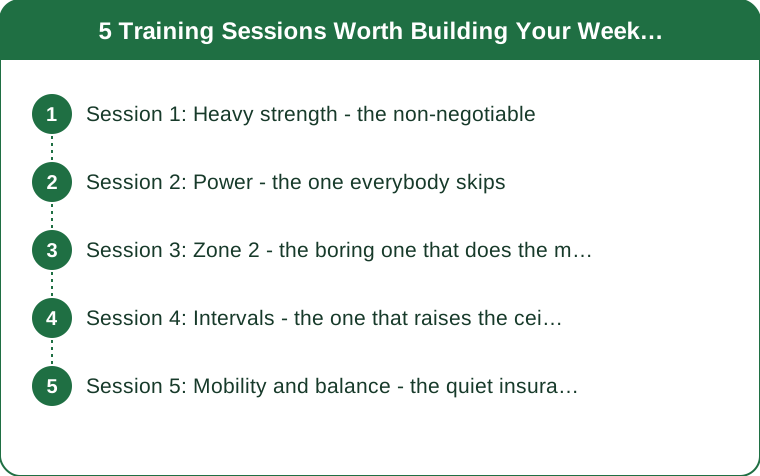
Session 1: Heavy strength - the non-negotiable
Twice a week, and this is the one with no substitute.
What it looks like. Three to five compound movements, 3 to 5 sets of 4 to 8 reps, at a load where the last two reps are genuinely hard. Squat or split squat, a hinge, a press, a row, and a carry covers everything that matters.
Why it matters most. Muscle mass declines around 3 to 8 percent per decade after 30 and faster after 60, and resistance training is the only intervention that reverses it. It also loads bone, which becomes a central concern around and after menopause.
What changes after 40:
- Longer warm-ups. Tissue takes longer to become compliant - 10 to 15 minutes rather than 5
- More warm-up sets, smaller jumps. The ramp matters more than it used to
- Slightly lower frequency per movement, slightly higher quality. Recovery between hard sessions genuinely takes longer
- Protein matters more. Older muscle is less responsive to the same stimulus, so both the training and the protein intake need to be adequate
The single most common mistake: going too light because it feels sensible. Loads that never challenge you produce no adaptation, and gentle training is the fastest route to losing the capacity you were trying to protect. Heavy and well-executed beats light and frequent, at every age.
Session 2: Power - the one everybody skips
Once or twice weekly, and it takes 15 minutes.
What it looks like. Fast, explosive intent with light to moderate load. Medicine ball throws, jump squats, box step-ups done quickly, kettlebell swings, or simply standing up from a chair as fast as you can. 3 to 5 sets of 3 to 5 reps, with full rest - this is quality work, not conditioning.
Why it matters so much. Power declines roughly twice as fast as strength after 40, because it depends on fast-twitch fibres that are preferentially lost. And power is what catches you when you stumble - the corrective response to a trip happens in a fraction of a second, which is a power task, not a strength one.
The functional translation. Getting up from a low chair quickly, crossing a road before the lights change, catching yourself on stairs. These are all power, and they are the capacities people notice going first.
How to do it safely if joints are a concern:
- Speed of intent matters more than the movement. A fast concentric on a leg press trains power without impact
- Medicine ball throws load the upper body explosively with no joint stress
- Start with low-amplitude work - fast step-ups before jumps, jumps before landings from height
- Always fresh, never at the end of a hard session. Power work when tired is where people get hurt
Fifteen minutes, twice a week, and it addresses the fastest-declining capacity you have.

Session 3: Zone 2 - the boring one that does the most
Two to four sessions weekly, 45 to 60 minutes each, at conversational pace.
What it looks like. Brisk walking, easy cycling, swimming, or slow running - anything where you could hold a full conversation but would rather not. If you are gasping, it is too hard; if you could sing, it is too easy.
Why it matters. This builds the aerobic base - mitochondrial density, capillary networks, and fat oxidation - which is the foundation everything else sits on. VO2 max is among the strongest predictors of all-cause mortality in the literature, and zone 2 work builds the base that allows it to improve.
Why people skip it. It is slow, it is unglamorous, and it takes time. The temptation after 40 is to make every session count by making it hard, which produces a week of moderate-intensity work that is too hard to recover from and too easy to drive adaptation.
The practical points:
- This is where volume lives. Three to four hours weekly is a reasonable target, and walking counts
- Low impact is fine - cycling, swimming, and incline walking all work, which matters if joints are a consideration
- It recovers easily, so it does not compete with your strength sessions the way interval work does
- Combine it with life. Walking commutes, dog walks, and weekend hikes are all zone 2 and cost you no extra time
If you only add one thing to a week that already has strength training, this is it.
Session 4: Intervals - the one that raises the ceiling
Once weekly is enough. Twice is the maximum for most people over 40.
What it looks like. The most-studied protocol is four minutes hard, three minutes easy, repeated four times - after a proper warm-up. Hard means you can speak two or three words, not a sentence. Alternatives include 30-second sprints with full recovery, or hill repeats.
Why it matters. Zone 2 builds the base; intervals raise VO2 max specifically, and VO2 max is the capacity most strongly associated with later-life independence. This is the session that moves the ceiling rather than filling in underneath it.
Why once a week. Interval work is expensive to recover from and that cost rises with age. Two hard sessions plus two heavy strength sessions is already a demanding week, and the most common overreach after 40 is doing three or four hard sessions and recovering from none of them.
What changes after 40:
- Longer warm-up - 15 minutes minimum before the first hard effort
- Full recovery between efforts. The rest is part of the session, not wasted time
- Low-impact options are entirely valid - bike, rower, and incline treadmill all work
- Place it away from heavy strength days by at least 24 hours
The signal you have overdone it: elevated resting heart rate, poor sleep, and sessions that feel harder at the same numbers for more than a few days. That is a week to reduce, not to push through.
Session 5: Mobility and balance - the quiet insurance
One dedicated 30-minute session, plus five minutes daily.
What it looks like. Loaded stretching through full ranges, single-leg balance work, thoracic and hip mobility, and getting up and down off the floor repeatedly. Not a passive stretching session - range that is trained under some load is retained far better than range that is only stretched into.
Why it matters. Balance is the capacity where decline turns into an event. A fall is how gradual loss becomes a hospital admission, and after a hip fracture in later life the outcomes are frequently poor. Meanwhile, range of motion is lost silently - it does not hurt, so you simply stop reaching the top shelf and adapt without noticing.
The five-minute daily piece matters more than the weekly session:
- Single-leg stand while the kettle boils - 30 seconds each side, eyes open, then eyes closed against a wall
- Overhead reach against a wall, ten slow repetitions
- A deep squat hold, 30 seconds
- Get down to the floor and back up once, deliberately
The floor test is the best single self-assessment you have. It integrates strength, power, balance, and range in one movement, and if it is getting harder, something in the other four sessions needs attention.
Putting the week together. Monday heavy strength, Tuesday zone 2, Wednesday power plus mobility, Thursday zone 2, Friday heavy strength, Saturday intervals, Sunday walk. That is roughly five to six hours across a week, it covers every capacity, and it is a template rather than a prescription - shift it to fit your life and keep the five session types intact. If you have any medical condition or are returning from injury, get this checked against your own situation first. This is general information, not medical advice.
TL;DR:
- Five session types cover the capacities that decline independently after 40
- Heavy strength twice weekly has no substitute, and going too light is the common mistake
- Power declines twice as fast as strength and is what catches you when you stumble
- Zone 2 is the boring foundation; one interval session per week raises the ceiling
- Balance and range need five minutes daily more than they need a weekly session
Look at last week’s training and count how many of the five you actually did. The missing one is usually power.
Keep Reading
This article is for general informational and styling purposes only. Fit, sizing, and product availability may vary.