5 Warm-Up Additions Worth Making After 40
Quick Answer: Five additions earn their place after 40: a longer general warm-up to raise tissue temperature, deliberate joint circles through full range for the shoulders and hips, a loaded mobility drill in the position you are about to train, a nervous system primer such as light jumps or medicine ball throws, and more warm-up sets with smaller jumps. Together they take 12 to 15 minutes and they change how the first working set feels more than anything else you can do.
The usual advice for training after 40 is warm up more, which is true and unhelpfully vague.
Here are the five specific additions, what each one addresses, and roughly how long each takes.

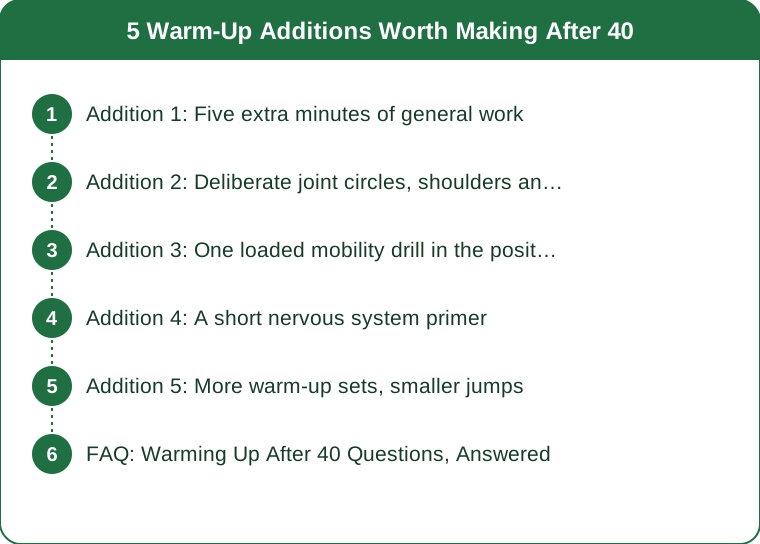
Addition 1: Five extra minutes of general work
Before anything else, extend the general portion from 5 minutes to 10 or 12. Easy bike, rower, incline walk, or brisk skipping. The goal is a light sweat and warm hands, nothing more.
What it addresses: muscle temperature, which directly affects contractile force and rate of force development. Warmer muscle produces more force and is more compliant, and tissue takes 10 to 20 minutes of activity to reach working temperature rather than 5.
Why it matters more after 40: resting tissue stiffness increases with age, and connective tissue compliance is more temperature-dependent. The same 5-minute warm-up leaves you further from ready than it did at 25.
Practical note: this is the addition people skip because it feels like wasted time, and it is the one with the clearest physiological justification. It is also the easiest to do while thinking about the session.
Addition 2: Deliberate joint circles, shoulders and hips
Ten slow controlled circles in each direction at each shoulder and each hip, taken to the edge of your available range without forcing. Two to three minutes total.
What it addresses: synovial fluid distribution and joint capsule preparation. Moving a joint through its full range circulates fluid and warms the capsule, which improves the position you can access under load a few minutes later.
Why shoulders and hips specifically: they are the two joints with the largest available range, the most soft tissue involvement, and the highest rate of degenerative change with age. They are also the two that limit squat, press, and hinge positions most often.
How to do it well: slow, actively controlled, no momentum, and going to the point of restriction rather than through it. Fast arm swings are not the same drill and do considerably less.
Addition 3: One loaded mobility drill in the position you will train
Pick one and spend two minutes: a goblet squat held at the bottom for 20 to 30 seconds, a deep lunge with a rotation, an overhead dowel or band pass, or a hanging shoulder stretch.
What it addresses: the specific end-range position your session will demand, under a small load so the nervous system accepts it. Passive stretching improves range briefly and does not prepare you to produce force there. Loaded end-range work does both.
Why this is the most transferable of the five: it directly rehearses the position that limits the lift. If your squat depth is restricted, a loaded bottom-position hold addresses it more effectively than any amount of general mobility work.
Matching the drill to the session: goblet squat holds before lower body, overhead band passes and hangs before pressing, deep lunge with rotation before anything involving the hips. One drill, chosen deliberately, beats a circuit of five done vaguely.

Addition 4: A short nervous system primer
Ten to twenty low-effort explosive repetitions before your first working set. Light box jumps, medicine ball throws, band-resisted punches, or a few fast bodyweight jump squats. Ninety seconds.
What it addresses: rate of force development and high-threshold motor unit recruitment, both of which decline with age faster than maximal strength does. Explosive work before heavy work primes the nervous system for fast, coordinated recruitment.
Why after 40 specifically: power declines earlier and faster than strength across the lifespan, and the ability to recruit quickly is what keeps you able to catch yourself when you stumble. A primer is training that quality, briefly, every session.
Keep the effort low and the quality high. This is not conditioning. Ten crisp reps with full recovery beats thirty fatigued ones, and any fatigue you create here comes straight out of your working sets.
Addition 5: More warm-up sets, smaller jumps
Add two more warm-up sets before your first working weight, and shrink the increments. For a 100kg working weight, that means roughly empty bar, 40, 55, 70, 82, 92, then 100 rather than three jumps.
What it addresses: post-activation potentiation, which primes each subsequent set, plus force calibration, so your brain has accurate information about the load. It also gives connective tissue graded exposure rather than a large step.
Why the payoff is larger after 40: tissue tolerates graded loading better than abrupt loading, and the potentiation effect means your first working set performs like your third. Most people over 40 report that their second working set is their best, which is a warm-up signal rather than a fact of life.
Total time for all five: 12 to 15 minutes. That is real time out of a session, and the trade is a first working set that is worth doing and a lower chance of losing a week to something that did not need to happen.
Seasonal note: all five matter more as gyms cool through autumn and winter, and the general warm-up addition matters most of all. If your warm-up worked in July and the first set feels bad in October, add the five minutes back before you conclude anything about your training.
This is general information, not medical advice. Pain that a warm-up does not resolve, or that changes your movement, is worth having assessed.
FAQ: Warming Up After 40 Questions, Answered
How long should a warm-up take after 40?
Around 12 to 15 minutes for a strength session: 10 to 12 minutes of general work and mobility, plus the warm-up sets. Muscle temperature takes 10 to 20 minutes of activity to reach working levels.
Should I stretch before lifting after 40?
Prefer loaded end-range work such as a held goblet squat over long passive stretching. It improves the position and prepares you to produce force in it, which passive stretching does not.
Why does my second working set feel better than my first?
Post-activation potentiation and force calibration. Each set primes the next. Adding two more warm-up sets with smaller jumps usually moves that quality into the first set.
TL;DR:
- Add five minutes of general work. Muscle temperature needs 10 to 20 minutes of activity, and stiffness is more temperature-dependent with age.
- Slow controlled joint circles at shoulders and hips, then one loaded mobility drill in the position you are about to train.
- Add a 90-second explosive primer, since power declines faster than strength and recruitment speed is trainable.
- Add two warm-up sets with smaller jumps, so your first working set performs like your third.
Total cost is 12 to 15 minutes. If your second set is always better than your first, that is a warm-up problem, not your age.
Keep Reading
This article is for general informational and styling purposes only. Fit, sizing, and product availability may vary.