5 Warmup Changes That Actually Matter Once You're Training Past 40
Quick Answer: Past 40, tendons and connective tissue take longer to reach full elasticity, joint fluid takes longer to circulate, and recovery from the previous session may still be incomplete — which together mean a warmup needs roughly double the time and a more gradual intensity ramp than it did in your 20s to actually prepare the body for hard training.
The five-minute warmup that used to be plenty now leaves you feeling stiff into your first working set. That’s not a sign of getting old and slow — it’s a sign your warmup needs to catch up to what your body actually needs now.

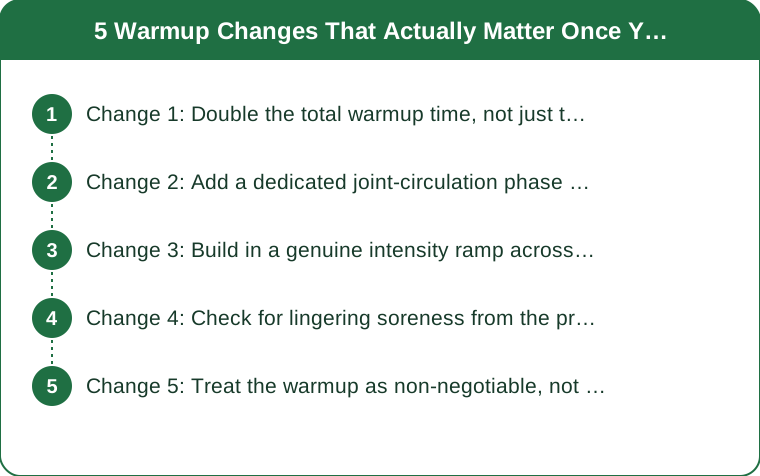
Change 1: Double the total warmup time, not just the intensity
Connective tissue elasticity develops more slowly with age, meaning the same warmup intensity reached in five minutes at 25 may genuinely need eight to ten minutes to produce the same tissue readiness after 40. This isn’t about doing more exercises — it’s about giving the same warmup sequence more time to actually take effect before loading it with real weight.
Change 2: Add a dedicated joint-circulation phase before dynamic stretching
Synovial fluid, which lubricates joints, circulates more slowly at rest with age, so starting directly into dynamic stretches without a brief joint-mobilization phase (ankle circles, hip circles, shoulder rolls) first often means stretching tissue that hasn’t yet gotten adequate lubrication. A two-minute joint-circulation phase before dynamic movement noticeably improves how the rest of the warmup feels.

Change 3: Build in a genuine intensity ramp across multiple warmup sets
Jumping from a light warmup directly to a heavy working weight is a bigger jump past 40 than it used to be, since tissue and nervous system readiness both benefit from a more gradual buildup. Adding two to three graduated warmup sets at increasing percentages of the working weight, rather than one light set followed by the full weight, closes this gap effectively.
Change 4: Check for lingering soreness from the previous session before assuming full recovery
Recovery between sessions genuinely takes longer past 40, and a warmup that assumes full recovery from two days ago may be starting from an inaccurate baseline. A quick honest check-in on how the body actually feels, rather than just following the same fixed warmup regardless of recovery status, allows for adjusting warmup length or intensity on days that need it.
Change 5: Treat the warmup as non-negotiable, not the first thing to cut when short on time
A rushed or skipped warmup is a more common cause of avoidable soft-tissue strain past 40 than it was at 25, since less forgiving connective tissue makes jumping into working weight without adequate preparation a genuinely higher-risk decision. Protecting warmup time, even by shortening the main workout instead, is a trade worth making consistently at this stage of training.
TL;DR:
- A warmup that took 5 minutes in your 20s may genuinely need 8-10 minutes past 40 to produce the same readiness
- Adding a dedicated joint-circulation phase before dynamic stretching helps lubrication catch up
- Building a genuine multi-step intensity ramp reduces the jump from warmup to working weight
- Protecting warmup time, rather than cutting it first when short on time, avoids the injuries that are costlier to recover from now
None of these changes require more total training time — they just shift where that time goes, which tends to pay off in fewer setbacks and better working sets.
Keep Reading
This article is for general informational and styling purposes only. Fit, sizing, and product availability may vary.