5 Ways Heat Changes Your Training After 40
Quick Answer: Heat tolerance declines with age through five specific changes - reduced sweat rate, a blunted thirst signal, slower cardiovascular adjustment, longer recovery from heat strain, and higher likelihood of taking medication that affects thermoregulation. None of them means stopping. All of them mean training earlier, hydrating on a schedule rather than by thirst, and giving yourself an extra day after hot sessions.
The adjustments are small. Skipping them is what turns a summer into a lost training block.

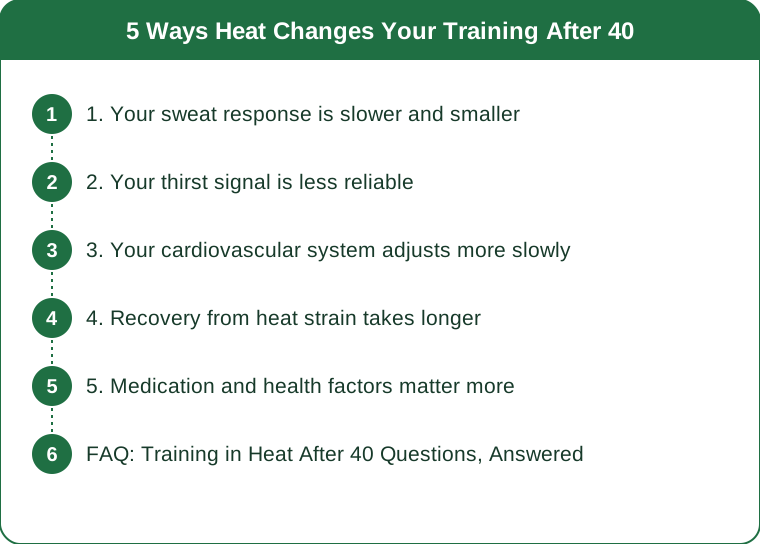
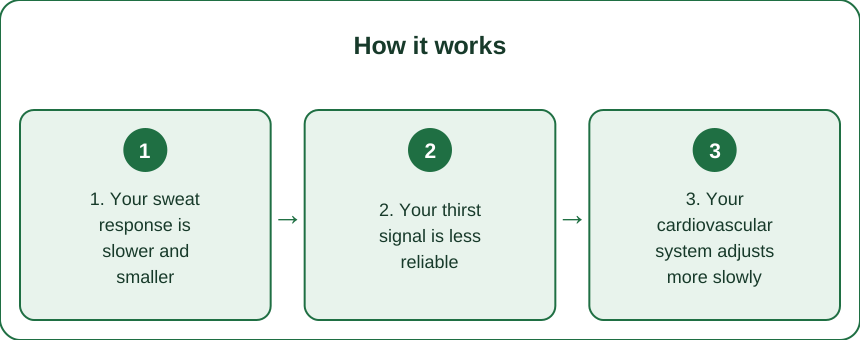
1. Your sweat response is slower and smaller
Sweating is the primary cooling mechanism, and it changes measurably with age.
Older adults generally show a reduced sweat rate per gland and a delayed onset of sweating compared with younger adults doing the same work in the same conditions. The sweat glands become less responsive, and the threshold core temperature at which sweating begins rises slightly.
The practical effect: you start cooling later and cool less efficiently, so core temperature climbs higher for the same workload. A session that produced a comfortable sweat at 30 now produces a delayed one at 50, with more heat retained in between.
What to do about it:
- Pre-cool before hard sessions in heat. A cold drink and a cold towel on the neck before starting genuinely lowers the starting point.
- Extend the warm-up but reduce its intensity. You need the tissue prepared without adding heat you cannot shed.
- Wear fabrics that let sweat evaporate - light, loose, synthetic. Reduced sweat production means the sweat you do produce needs to work harder, and cotton holding it against your skin wastes it.
- Take cooling breaks deliberately. Two minutes in shade with cold water on wrists and neck every 15 minutes in hot conditions.
This is a change in capacity, not a signal to stop. Heat acclimatization still works at every age - 10 to 14 days of consistent exposure improves sweat rate and onset timing in older adults as it does in younger ones.
2. Your thirst signal is less reliable
This one is the most consequential and the least visible.
The thirst response is measurably blunted with age. Older adults tend to feel thirsty at a greater degree of fluid deficit than younger adults, and drink less when they do. Kidney function also changes - the ability to concentrate urine declines, so more fluid is lost for the same waste excretion.
The combination means you can be meaningfully dehydrated before feeling any urge to drink, and dehydration compounds every other heat problem: less blood volume means less skin blood flow, which means less cooling, which means a higher core temperature at the same effort.
What to do about it:
- Drink on a schedule, not by thirst. This is the single most important adjustment in this article. Roughly 16 to 20 ounces in the two hours before a session, and 4 to 8 ounces every 15 to 20 minutes during it.
- Check urine colour in the morning and after sessions. Pale straw is the target. This is a more reliable indicator than how thirsty you feel.
- Weigh yourself before and after long hot sessions. Each pound lost is roughly 16 ounces of fluid to replace. A loss over 2 percent of body weight means you under-drank substantially.
- Add sodium for anything over an hour in heat. Older adults lose sodium in sweat at similar rates, and replacing water alone in large volumes carries its own risks.
Alcohol and caffeine both matter more here than they did at 30, because the margin for error is smaller.
3. Your cardiovascular system adjusts more slowly
Exercising in heat is a competition for blood flow. Working muscles need it and the skin needs it for cooling, and the heart has to supply both.
Maximum heart rate declines with age, and so does the heart’s ability to rapidly increase stroke volume. The result is less cardiovascular reserve for the extra demand that heat imposes. In practical terms, heart rate at a given pace rises further and faster in hot conditions than it used to, and it takes longer to come back down.
This is why the classic experience of a masters athlete in summer is that the pace feels the same but the heart rate is 15 beats higher and the session feels twice as hard.
What to do about it:
- Train by effort or heart rate, not by pace. Your usual pace in 90-degree heat is now a genuinely harder session. Holding it is not discipline; it is a miscalculation.
- Expect and accept a 20 to 30 percent reduction in intensity in hot conditions, and put the hard work back in when the mornings cool.
- Extend rest intervals. If you normally take 90 seconds between hard efforts, take two to three minutes in heat, because heart rate recovery is slower.
- Watch the first ten minutes. Cardiovascular adjustment to heat takes longer with age, so starting conservatively matters more than it used to.
Move sessions to early morning wherever possible. A 6:30am session in August can be 15 to 20 degrees cooler than a 5pm one, and that difference is larger than any training adaptation you could make.

4. Recovery from heat strain takes longer
A hot session costs more than a cool one, and the extra cost is paid over the following days.
Heat exposure adds physiological stress on top of the training stress. Core temperature elevation, fluid and electrolyte loss, and higher cardiovascular strain all take time to resolve. With age, that resolution is slower - the same process that lengthens recovery from a hard session generally applies to heat strain specifically.
What this looks like in practice: a hot Saturday long run that would once have been fine by Monday now leaves you flat until Tuesday. People interpret this as declining fitness. It is usually unrecovered heat strain being stacked with the next session.
What to do about it:
- Add a day. If your normal pattern is hard-easy-hard, make it hard-easy-easy in the hottest weeks. The total training load stays similar while the recovery matches what the conditions demand.
- Rehydrate deliberately over the following 24 hours, not just immediately after. Full rehydration after a heavy sweat session takes considerably longer than most people allow.
- Prioritize sleep in hot weeks. Hot nights fragment sleep, and sleep is where the recovery actually happens. Cooling the bedroom is a training intervention in July and August.
- Watch morning resting heart rate. An elevation of five or more beats above your normal, persisting for two days, is a reliable signal that you have not recovered.
Plan the season around it. Treating late summer as a maintenance block rather than a building block is not a concession - it is what allows the autumn block to go well.
5. Medication and health factors matter more
This one is not about fitness, and it is the one with the highest stakes.
A number of commonly prescribed medications affect thermoregulation, and the likelihood of taking one rises with age:
- Diuretics reduce blood volume and increase fluid loss
- Beta blockers blunt heart rate response and reduce skin blood flow
- Some antihypertensives affect blood pressure regulation in heat
- Anticholinergics and some antihistamines can reduce sweating directly
- Some antidepressants affect thermoregulation
None of these means you cannot train in heat. They mean the margins are smaller and the adjustments matter more, and it is worth a specific conversation with your prescriber about exercising in hot weather rather than assuming it is fine.
Underlying conditions matter too. Cardiovascular disease, diabetes, and thyroid conditions all affect heat tolerance. Again, not disqualifying - but a reason to be deliberate rather than casual.
Know the warning signs and treat them as absolute:
- Dizziness, nausea, or headache
- Confusion or difficulty concentrating
- Skin that has stopped sweating and feels hot and dry
- A heart rate that does not settle during rest intervals
- Muscle cramping that is severe or widespread
Any of these means stop, get to shade or air conditioning, cool actively, and drink. Heat illness progresses quickly and it is more dangerous with age. Confusion or absent sweating is an emergency and warrants calling for help rather than driving home.
This is general information, not medical advice - if you take any of the medications above, or have a cardiovascular or metabolic condition, discuss hot weather training with your clinician specifically.
FAQ: Training in Heat After 40 Questions, Answered
Does heat acclimatization still work at my age?
Yes. Ten to fourteen days of consistent, moderate exposure improves sweat onset, sweat rate, and cardiovascular strain in older adults. Start conservatively and build - do not acclimatize by doing your hardest session in the worst conditions.
How much should I actually reduce intensity?
Roughly 20 to 30 percent in genuinely hot conditions, judged by effort rather than pace. If a heart rate monitor shows you 15 beats above normal at your usual pace, that is the size of the adjustment you need.
Is indoor training a cop-out?
No - it is the sensible option on the worst days, and it lets you actually complete quality work rather than surviving a session. Air-conditioned strength work and indoor cardio are legitimate summer training, not a compromise.
What time of day is best?
Early morning, clearly. It is the coolest part of the day, the UV index is lower, and you finish before the heat builds. Evening is second best and still considerably warmer than dawn.
Should I use electrolyte drinks or just water?
Water is fine under an hour. Beyond an hour in heat, add sodium. If you are on a diuretic or have been advised about sodium intake, ask your clinician what applies to you specifically.
TL;DR:
- Sweat onset is later and sweat rate lower with age, so core temperature climbs higher for the same work. Pre-cool and take cooling breaks.
- Thirst is a blunted signal after 40. Drink on a schedule - 16 to 20 ounces before, 4 to 8 ounces every 15 to 20 minutes during.
- Cardiovascular reserve for heat is smaller. Train by effort, expect a 20 to 30 percent intensity reduction, and extend rest intervals.
- Heat strain recovery is slower. Add an easy day in hot weeks and watch morning resting heart rate.
- Several common medications affect thermoregulation. Know the warning signs and treat them as non-negotiable.
Train at dawn, hydrate by the clock, and treat late summer as a maintenance block. Autumn is where the gains are.
Keep Reading
This article is for general informational and styling purposes only. Fit, sizing, and product availability may vary.