5 Photo Checkpoints That Track a Masters Athlete's Progress Better Than the Scale
Quick Answer: For a masters athlete, five photo checkpoints — relaxed standing posture, a mid-set training photo, a post-workout recovery-day comparison, a grip/hand photo during a lift, and a side profile during a warmup stretch — track real functional progress that the scale misses entirely, especially since muscle and inflammation shifts after 40 can move body weight in either direction independent of actual fitness gains.
A masters athlete who trains hard for months can step on the scale and see almost nothing move, while five specific photos taken over that same stretch tell a completely different, far more accurate story.

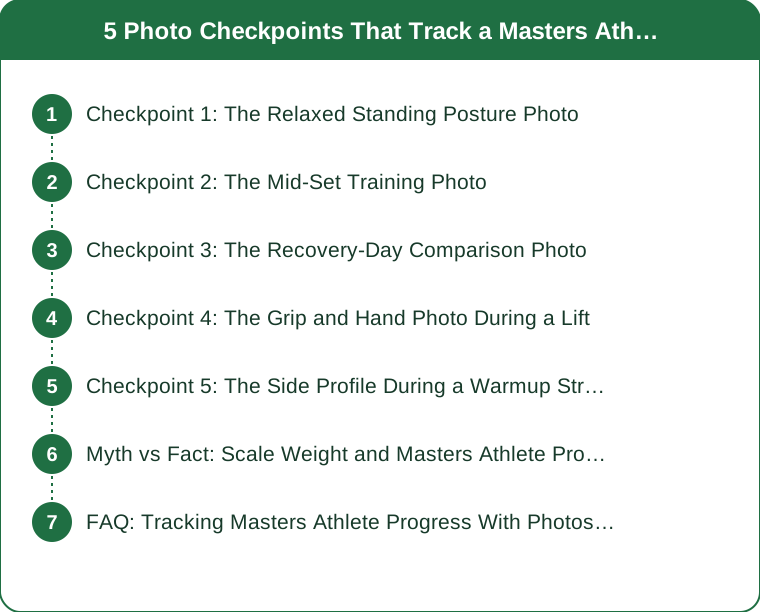
Checkpoint 1: The Relaxed Standing Posture Photo
A simple front-facing photo, standing relaxed with no attempt to “suck in” or pose, taken from the same spot and distance every few weeks, reveals postural changes that scale weight never will. Improved thoracic extension, less forward head carriage, and more even shoulder height are all things a masters athlete’s body genuinely changes as core and back strength improve — and every one of those changes is invisible on a scale but obvious across a photo series.
Checkpoint 2: The Mid-Set Training Photo
A photo taken mid-rep during a familiar compound lift — squat depth, deadlift lockout, a plank hold — captures form quality and control that raw numbers on a whiteboard don’t show. Comparing the same exercise photographed months apart often reveals a noticeably more stable, controlled position at the same or even a lighter working weight, which is a meaningfully different and more valuable signal than whether the scale moved.
Checkpoint 3: The Recovery-Day Comparison Photo
A photo taken the day after a hard session, showing general puffiness, posture, and energy in the face and stance, tracks recovery capacity — one of the things that changes most after 40. Recovery photos taken consistently over months tend to show less visible next-day inflammation and a more upright, less guarded stance over time, even when the workouts themselves haven’t gotten any easier.

Checkpoint 4: The Grip and Hand Photo During a Lift
A close photo of grip position during a loaded carry or deadlift shows something the scale can never measure: grip strength, which is one of the more reliable markers of overall functional aging in research on masters athletes. A firmer, less strained-looking grip on a comparable load over time is a genuinely meaningful marker of durability that most progress-tracking methods ignore entirely.
Checkpoint 5: The Side Profile During a Warmup Stretch
A side-view photo taken during a consistent warmup stretch — a hip flexor lunge or a standing forward fold — tracks mobility range that tends to shift gradually and easily goes unnoticed day to day. Comparing this photo every month or two often reveals meaningfully more range even when nothing about the number on the scale has moved at all.
Myth vs Fact: Scale Weight and Masters Athlete Progress
Myth: If the scale isn’t moving, training isn’t working. Fact: Strength, posture, recovery capacity, and mobility all improve independently of body weight, especially after 40 when muscle gain and fat loss can happen simultaneously and cancel out on the scale.
Myth: Progress photos are just for physique-focused goals. Fact: The five checkpoints above track functional aging markers — posture, grip, recovery, mobility — that matter far more to a masters athlete’s actual performance and longevity than aesthetics ever did.
FAQ: Tracking Masters Athlete Progress With Photos, Answered
How often should these checkpoint photos actually be taken?
Every 4-6 weeks is frequent enough to catch real change without the noise of day-to-day fluctuation, and consistent lighting and framing matter more than frequency for making the comparison useful.
Should these photos replace strength and performance tracking entirely?
No — they work best alongside logged weights, reps, and recovery notes, filling in the postural and recovery-capacity gaps that raw numbers alone don’t capture.
What if the photos don’t show obvious change for a few months?
Some of these markers, especially posture and grip, shift slowly and unevenly — a longer comparison window (three to four checkpoints apart) is often needed before the change becomes visually obvious.
TL;DR:
- The scale misses posture, recovery capacity, grip strength, and mobility — all things that meaningfully improve after 40
- Five consistent photo checkpoints (posture, mid-set, recovery-day, grip, mobility profile) capture what weight can’t
- Comparing photos every 4-6 weeks with consistent framing makes real change visible over time
- Pair photo checkpoints with logged training numbers rather than replacing one tracking method with the other
A masters athlete’s real progress usually shows up in how a lift looks, how fast the next-day puffiness fades, and how far a stretch reaches — not in a number that was never designed to measure any of that.
Keep Reading
This article is for general informational and styling purposes only. Fit, sizing, and product availability may vary.