Five Training Adjustments That Matter Most After Fifty
Quick Answer: Five adjustments carry most of the benefit after fifty: train power explicitly (it declines twice as fast as strength), extend the warm-up to 12 to 15 minutes, spread protein across meals at 25 to 40g each, add a recovery day rather than removing a training day, and keep hard days genuinely hard instead of drifting everything to moderate. Volume rarely needs to fall much - recovery time and warm-up time both do need to rise.
Each of these addresses a specific measurable change, which is why they beat general advice to take it easier.

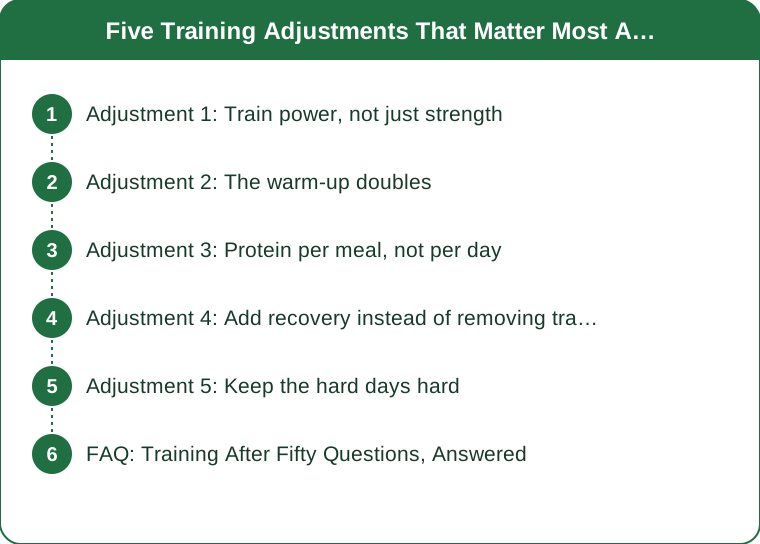
Adjustment 1: Train power, not just strength
This is the single most commonly skipped adjustment and the one with the most direct payoff.
Power declines roughly twice as fast as strength after fifty. Power is force produced quickly, and it depends heavily on fast-twitch motor units - which are lost preferentially with age.
Almost nobody over fifty trains fast on purpose. Strength training after fifty typically becomes slower and more careful, which is understandable and which accelerates exactly the quality that matters most.
Power training does not mean heavy or risky. It means moving a light-to-moderate load with maximum intent, typically 40 to 60 percent of your maximum, for 3 to 5 reps so no rep is slow.
Concrete options that are joint-friendly: fast sit-to-stands from a chair, med ball throws against a wall, hard-driven step-ups, kettlebell swings if the hinge is solid, or simply the concentric portion of your normal exercises moved as fast as control allows.
Two exercises, twice a week, is enough - and it is the difference between catching a stumble and not.
Adjustment 2: The warm-up doubles
The single most common source of masters injuries is a warm-up designed for a thirty-year-old.
Connective tissue takes longer to become compliant. Tendons and fascia respond more slowly to warming, and synovial fluid distribution across joint surfaces takes more time.
Five minutes becomes 12 to 15. This is not lost training time - it is the reason the session happens next week too.
Structure it in three parts. 5 minutes of general warming - bike, brisk walk, rower - to raise tissue temperature. 5 minutes of dynamic mobility targeting the joints in the session: hip circles, thoracic rotations, ankle rocks, shoulder passes. 3 to 5 minutes of specific ramp-up sets with progressively heavier loads of the first exercise.
Skip static stretching beforehand. Holding a stretch before training can transiently reduce force output, and it does not reduce injury risk. Save it for after, if you want it.
The ramp-up sets do double duty. They warm the tissue and they tell you what kind of day it is. A bar that feels heavy in the ramp-up is information - it is a signal to adjust the session rather than push through it.
Adjustment 3: Protein per meal, not per day
The daily total gets the attention and the per-meal distribution is where the problem usually is.
Anabolic resistance means the same protein dose produces a smaller response. Older muscle needs a larger single dose to trigger the same muscle protein synthesis response as younger muscle.
The daily target rises: roughly 1.2 to 1.6g per kilogram of body weight, versus the general 0.8g/kg baseline.
The per-meal target matters more: 25 to 40g at each of three or four meals. A typical pattern of a light breakfast, a moderate lunch, and a large dinner misses the threshold twice and overshoots once - and the missed meals do not bank forward.
Breakfast is almost always the weak point. Toast, cereal, or fruit rarely clears 15g. Three eggs, Greek yoghurt with nuts, or a protein shake fixes the largest single gap most people have.
Leucine content drives the trigger, which favours dairy, eggs, meat, fish, and soy. Plant sources work but generally need larger portions or combining.
And this pairs with training rather than replacing it. Protein without a training stimulus does not build muscle; training without adequate protein wastes the stimulus.

Adjustment 4: Add recovery instead of removing training
The instinct after fifty is to train less. The better move is usually to train the same and recover more.
Recovery between hard sessions extends. Muscle protein synthesis remains elevated for a shorter period and inflammation resolves more slowly, which means 48 to 72 hours between hard sessions for the same muscle group rather than 48.
This changes the weekly shape, not the weekly volume. Three full-body sessions on Monday, Wednesday, and Friday works better than four sessions crammed into five days.
Sleep is the recovery variable with the most leverage and the one most disrupted in this age group. Sleep restriction reduces muscle protein synthesis and shifts weight loss toward lean mass - which undoes a large share of the training.
Active recovery beats complete rest on off days. A walk, easy cycling, or mobility work maintains blood flow without adding stress. Complete inactivity on rest days makes the next session feel worse, not better.
Deload every fourth to sixth week. Cut volume by roughly half for one week while keeping intensity. Masters trainees benefit from planned deloads more than younger trainees do, and the ones who skip them tend to take unplanned six-week breaks instead.
Adjustment 5: Keep the hard days hard
The most common masters training error is not overtraining. It is the slow drift of everything toward the middle.
Easy days creep up and hard days creep down. Over months, every session becomes moderately hard - too hard to recover fully, not hard enough to drive adaptation. This is sometimes called the grey zone, and it is where a lot of masters training quietly lives.
Polarise deliberately. Roughly 80 percent of your cardio genuinely easy - conversational, nose-breathing, slower than feels satisfying - and 20 percent genuinely hard.
In the gym, the equivalent is taking working sets close to failure. Stopping four reps short on every set, every week, is the strength version of the grey zone. Two hard sets beat five comfortable ones.
Easy days must actually be easy. This is harder psychologically than the hard days. If your easy run leaves you tired for the hard session, it was not easy.
Autoregulate rather than forcing the plan. Some weeks the hard day should become a moderate day, and that is a decision made from the warm-up, not from the schedule.
And the honest note about age: these adjustments make training sustainable, not unlimited. Progress is slower after fifty and it does not stop. The people still improving at sixty are almost always the ones who stayed consistent for a decade rather than the ones who trained hardest in any single year.
This is general information, not medical advice. Get medical clearance before starting a new programme, particularly with any cardiovascular or joint condition.
FAQ: Training After Fifty Questions, Answered
Should I train less often after fifty?
Usually not less often - just with more space between hard sessions for the same muscle group. Three full-body sessions spread across the week generally works better than four bunched together.
Is heavy lifting safe after fifty?
For most healthy adults with good technique, yes, and it is one of the better-supported interventions for bone and muscle. Loads taken close to failure at moderate weight achieve much of the same benefit with lower technical risk. Get clearance if you have any cardiovascular or joint condition.
How much protein do I actually need?
Around 1.2 to 1.6g per kilogram daily, split into meals of 25 to 40g. The per-meal distribution matters more after fifty than the daily total, and breakfast is usually the gap.
What is power training and why does it matter?
Moving a moderate load quickly, at around 40 to 60 percent of your maximum for 3 to 5 fast reps. It matters because power declines about twice as fast as strength and it is what you use to catch a stumble.
How long should my warm-up be?
12 to 15 minutes: general warming, dynamic mobility, then ramp-up sets. Connective tissue takes longer to become compliant, and this is where most masters injuries are prevented.
Do I need deload weeks?
Yes, and more than younger trainees do. Every fourth to sixth week, halve the volume while keeping intensity. Skipping them tends to produce unplanned longer breaks.
TL;DR:
- Train power explicitly - 40 to 60 percent of max, 3 to 5 fast reps - because power declines about twice as fast as strength.
- Warm up for 12 to 15 minutes in three parts, and skip static stretching beforehand.
- Protein per meal (25 to 40g) matters more than the daily total; breakfast is almost always the gap.
- Add recovery rather than cutting training: 48 to 72 hours between hard sessions, active rest days, and a deload every four to six weeks.
- Keep hard days hard and easy days easy - the grey zone in the middle is where masters progress goes to die.
None of these are about slowing down. They are about spending your recovery capacity on the things that still respond, which after fifty is a shorter and more specific list than it used to be.
This is general information, not medical advice.
Keep Reading
This article is for general informational and styling purposes only. Fit, sizing, and product availability may vary.