5 Training Adjustments That Matter Most After 40
Quick Answer: Five changes: double your warm-up, add a recovery day between hard sessions, keep intensity but reduce weekly volume, prioritize protein and sleep, and add dedicated tissue work. Notably, reducing intensity is not on the list — heavy training remains valuable and the research supports it. What changes is how often you can repeat hard work, not how hard the work should be.
The mistake isn’t training too hard after 40. It’s training hard too often, and warming up like you’re still 25.

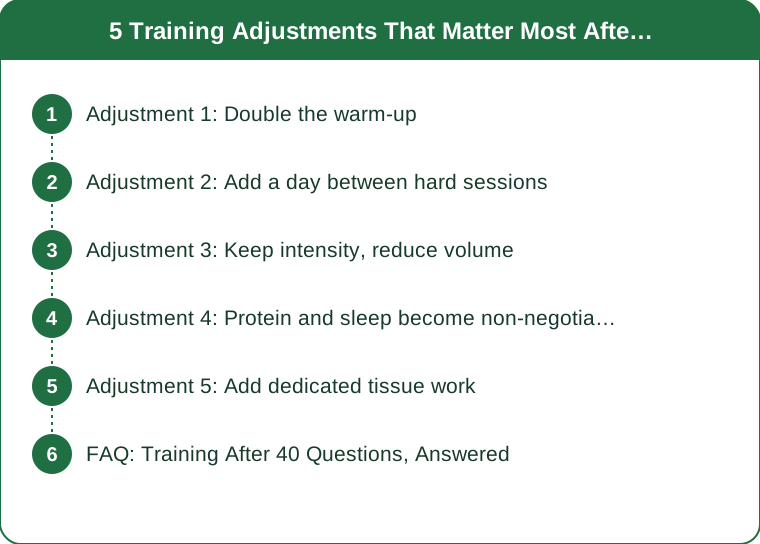
Adjustment 1: Double the warm-up
Ten to fifteen minutes, not three — and this is the change with the fastest visible return.
Connective tissue becomes stiffer with age and takes longer to become compliant. Synovial fluid distribution and tissue temperature both take longer to reach working condition.
The practical version: 5 minutes of general movement to raise temperature, 5 minutes of joint-specific mobility, then progressive warm-up sets.
Warm-up sets should be more numerous, not heavier. Where you might have done two before a working set, do four, adding smaller increments.
Most people report that the third or fourth set of an exercise feels best. That’s the warm-up finishing. The goal is to arrive at your first working set already at that point.
Time cost: about 10 extra minutes. Return: noticeably better sessions and fewer irritations. This is the highest ratio of benefit to effort on the entire list.
Adjustment 2: Add a day between hard sessions
Recovery capacity is what changes most, and it’s the adjustment people resist hardest.
Muscle protein synthesis response and inflammatory clearance both slow with age. A session that needed 48 hours at 25 often needs 72 at 45.
Training into incomplete recovery is the mechanism behind most mid-life overuse injuries. The training wasn’t too hard — it was repeated too soon.
Practical: if you trained heavy legs Monday, don’t train heavy legs Wednesday. Thursday or Friday. Fill the gap with easy movement, mobility, or a different body part.
Frequency, not intensity, is the dial to turn. Three quality sessions per week beats five compromised ones, and this is where most people over 40 get it backwards.
Watch for the signals: persistent soreness, declining performance across weeks, poor sleep, or elevated resting heart rate. Those mean take an extra day, not push harder.
Adjustment 3: Keep intensity, reduce volume
Heavy training remains valuable. Total weekly volume is what should come down.
Heavy resistance training is one of the better-supported interventions for maintaining muscle mass, bone density, and function with age. Backing off to light weights and high reps is a common mistake and it removes exactly the stimulus that matters most.
What tends to change is tolerance for total weekly work. Fewer total sets, at good intensity, generally produces better results than the same volume at lower intensity.
Practical: cut total sets per muscle group by roughly 20 to 30% from what you’d have done a decade ago, and keep the loads.
Quality over quantity in the literal sense. Three excellent hard sets beat six mediocre ones, particularly when recovery is the limiting factor.
Keep some near-maximal work in the program. Heavy singles, doubles, and triples maintain neural qualities and are typically less fatiguing than high-rep sets to failure. Training to failure repeatedly is a poor trade after 40 — high fatigue cost, marginal additional stimulus.

Adjustment 4: Protein and sleep become non-negotiable
Both matter more with age, not less — and both are what people cut first when busy.
Older muscle shows a blunted response to a given dose of protein. The practical response is more protein per meal and adequate total intake — around 1.6 to 2.2g per kg bodyweight for people training.
Distribution matters. Roughly 25 to 40g per meal across three or four meals appears more effective than the same total concentrated in one.
Sleep is where recovery actually happens. Growth hormone release, tissue repair, and consolidation of motor learning all depend on it. Seven to nine hours, consistently.
Sleep quality also changes with age — more fragmentation, less deep sleep. Which means protecting the conditions matters more: consistent timing, cool dark room, limited alcohol.
Alcohol deserves specific mention. It measurably impairs sleep quality and muscle protein synthesis, and the effect is more noticeable with age. This isn’t a moral point — it’s a training variable that’s easy to overlook.
Adjustment 5: Add dedicated tissue work
Ten to fifteen minutes, two or three times a week, targeting tendons specifically.
Tendon collagen turnover slows considerably with age. Tendons respond well to slow, heavy loading and isometric holds — this is well established and underused.
Isometrics: 30 to 45 second holds against significant resistance. A wall sit for knees, a heavy carry hold for shoulders and grip, a mid-range hold for elbows.
Slow eccentrics: 3 to 5 second lowering phases on your main movements, at least periodically. This is where tendon adaptation happens.
Address the specific spots that complain. Most people over 40 have two or three recurring irritations — a shoulder, an elbow, an Achilles. Ten minutes of targeted loading a few times a week manages these far better than stretching or rest.
Do it consistently. Tendon adaptation is slow — 8 to 12 weeks to see meaningful change — which is exactly why the intermittent approach most people take doesn’t work.
Persistent pain, especially with weakness or night pain, deserves professional assessment rather than a self-directed program. This is general information, not medical advice.
FAQ: Training After 40 Questions, Answered
Should I stop lifting heavy?
No. Heavy resistance training is among the better-supported interventions for maintaining muscle, bone, and function with age. What changes is how frequently you can repeat it, not whether you should do it.
Is it too late to start if I’ve never trained?
No. Studies of resistance training in people in their seventies and eighties consistently show meaningful strength and muscle gains. The returns are typically largest for those starting from the lowest baseline — starting later means a bigger relative gain, not a smaller one.
Why do I get injured more easily now?
Usually a combination of slower tissue recovery, accumulated wear, and training habits carried over from a decade ago — particularly short warm-ups and inadequate recovery days. The first two are partly out of your control; the third is entirely within it.
How much cardio should I be doing?
General guidance of roughly 150 minutes of moderate activity per week applies and is well supported. Cardiorespiratory fitness is one of the strongest predictors of long-term health outcomes, and it’s worth protecting alongside strength rather than trading against it.
Does menopause change these recommendations?
It changes the context — bone density loss accelerates, body composition shifts, and sleep is often disrupted. The recommendations don’t reverse; if anything resistance training and protein become more important. It’s worth discussing individually with your physician.
TL;DR: Same program, five modifications. Reducing intensity isn’t one of them.
- Double the warm-up — 10 to 15 minutes, more warm-up sets at smaller increments. Best return on the list.
- Add a recovery day between hard sessions. 72 hours, not 48. Frequency is the dial, not intensity.
- Keep the loads, cut total volume 20 to 30%. Heavy training is what maintains muscle and bone.
- Protein 1.6 to 2.2g/kg, spread across meals. Sleep 7 to 9 hours. Both matter more now, not less.
- 10 to 15 min of tendon work, 2 to 3 times weekly — isometric holds and slow eccentrics. Give it 8 to 12 weeks.
The error isn’t training too hard after 40. It’s training hard too often, and warming up like it’s still 1998.
Keep Reading
This article is for general informational and styling purposes only. Fit, sizing, and product availability may vary.