Five Training Weeks That Actually Work After 45 — Laid Out Day by Day
Quick Answer: After 45 the problem is rarely total volume — it is how the hard days are spaced. Most masters athletes do better with two genuinely hard sessions, two moderate ones, and 72 hours between anything that loads the same joint heavily. The five week structures below all keep four to five training days; they just arrange them differently depending on what your life looks like.
You did not get weaker. Your recovery window got longer, and your old week never accounted for it.
Here are five weeks that do, each built around a different constraint — time, joints, travel, sleep, or a competing sport.

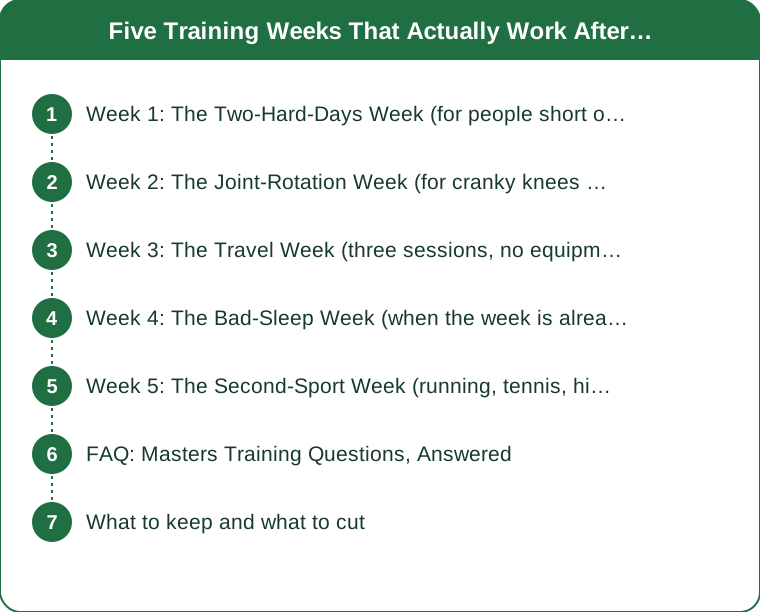
Week 1: The Two-Hard-Days Week (for people short on time)
This is the default for anyone training four days with a full schedule.
Monday — hard lower. Squat or hinge as the main lift, 3 sets of 5 at a weight you could do 7 with. Two accessories, 3 sets of 10. Out in 50 minutes.
Wednesday — hard upper. Press and row as the mains, same 3 by 5 structure, then two accessories.
Friday — moderate full body. Everything at roughly 60% of Monday’s load, 3 sets of 8, moving briskly. This is the day that maintains skill without adding fatigue.
Saturday — easy aerobic. 40 to 60 minutes of walking, cycling, or swimming at a pace where you can talk in full sentences.
Why it works: only two sessions in the week actually generate deep fatigue, and they are 48 hours apart with a moderate day between. Most people over 45 who feel constantly beat up are running four hard days and calling two of them moderate.
Week 2: The Joint-Rotation Week (for cranky knees or shoulders)
Built for the person who can train hard, just not the same joint twice in three days.
Monday — knee-dominant. Squat pattern, leg press, split squats.
Tuesday — horizontal push and pull. Bench or floor press, rows. Nothing overhead.
Thursday — hip-dominant. Deadlift or hip thrust, hamstring work, carries. The knee gets a full 72 hours.
Friday — vertical push and pull, or a second horizontal day if shoulders are the issue. Overhead work happens once a week here, not twice.
Sunday — 30 minutes of easy movement plus 10 minutes of the one mobility drill that actually helps you. Not a circuit. One drill.
Why it works: it separates pattern rather than muscle group. Your knees do not care that Monday was legs and Thursday was legs — they care that both days were deep knee flexion under load.
Week 3: The Travel Week (three sessions, no equipment guaranteed)
What you run when you are away and cannot count on a gym.
Day 1 — full body with whatever exists. If there are dumbbells: goblet squat, row, press, hinge, 3 sets of 10 each. If there is nothing: split squats, push-ups, single-leg hinges, planks, same volume.
Day 2 — walk. A real one, 45 to 60 minutes, ideally outside and ideally in the morning to help the time-zone problem.
Day 3 — repeat Day 1 with the reps changed. 4 sets of 6 if you have load, or add a slow three-second lowering phase if you do not.
Day 4 or 5 — one more full body session if the trip is longer than five days.
Why it works: maintenance genuinely takes about a third of what building takes. Two to three full-body sessions hold nearly everything for two to three weeks. The mistake is skipping entirely because the ideal week is not available.

Week 4: The Bad-Sleep Week (when the week is already going wrong)
This is not a lesser week. It is the correct week for the conditions.
Keep the frequency, cut the intensity. Same four days, but every set stops three or four reps short of hard. Load drops to about 70% of normal.
Cut the last exercise of every session. Not the first — the first is the one that maintains strength. The accessories are what accumulate the fatigue you cannot currently recover from.
Add 10 minutes of walking after each session instead of adding intensity anywhere.
Move the hard day to whichever morning followed the best night. Yes, this means planning the week on Wednesday rather than Sunday.
Why it works: under-slept training raises perceived effort and slows recovery without improving the adaptation. You are not being soft — you are refusing to pay full price for a discount result. Take the week, keep the habit, and resume loading when sleep does.
Week 5: The Second-Sport Week (running, tennis, hiking, or class)
For anyone whose real love is not the gym.
Two lifting days, both full body, both 45 minutes. Squat pattern, hinge, push, pull, carry. That is the whole session.
Place them at least 24 hours after the hardest sport day, never the day before. Legs full of lifting fatigue is how a tennis match turns into a hamstring problem.
Sport days stay as they are. Do not try to make them easier to accommodate lifting — the sport is the point.
One optional 20-minute session of single-leg work and mid-back work, whenever it fits. This is the insurance policy for the sport.
And one full rest day, non-negotiable. Not active recovery. Rest.
Why it works: it treats lifting as support rather than competition. The most common masters injury pattern is not from the sport or the gym alone — it is from both being scheduled as if the other did not exist.
FAQ: Masters Training Questions, Answered
How many hard days per week can I actually handle after 45?
Two is the reliable number for most people, three if sleep and nutrition are genuinely good and the hard days load different patterns. If you are ending every week feeling worse than you started it, you are running more hard days than you think — moderate days often creep up in intensity without anyone deciding they should.
Should I lift heavy at all after 45?
Yes, and this is the part that surprises people. Heavy work in the 3 to 6 rep range preserves the fast-twitch fibers and bone density that decline fastest with age. What changes is not the load, it is the warm-up length and the recovery gap. Sets of 5 with two extra warm-up sets beats sets of 15 for almost every goal that matters here.
Why does the same program feel harder in the fall?
Late summer into fall usually brings a schedule change, less daylight in the morning, and a drop in incidental outdoor activity. Training load stayed the same while total recovery capacity quietly dropped. If your week stopped working in September, adjust the week rather than concluding you have declined.
What to keep and what to cut
Keep: heavy compound lifts, four training days, walking, one hard aerobic effort per week.
Cut: the fourth accessory exercise, back-to-back hard days, and the belief that a week has to look identical every time.
Adjust: warm-ups get longer, not shorter — 10 to 15 minutes with progressive loading sets rather than five minutes on a bike.
The distinction that matters: you are not managing decline, you are managing recovery windows. Those are different problems with different solutions, and only one of them requires training less.
This is general information, not medical advice. If you have a joint issue that persists past two weeks or wakes you at night, see a professional before adjusting your program around it.
TL;DR:
- Two genuinely hard days per week, spaced 48+ hours apart, is the reliable structure after 45.
- Separate movement patterns, not muscle groups — knees care about deep flexion, not what you labeled the day.
- Maintenance takes about a third of what building takes, so travel weeks with two full-body sessions hold nearly everything.
- Bad sleep week means same frequency, 70% load, cut the last exercise — not skip the week. Pick the week that matches your actual constraint rather than the one that looks most impressive on paper. The best masters programs are the ones that survive contact with a real calendar, and all five of these are built to.
Keep Reading
This article is for general informational and styling purposes only. Fit, sizing, and product availability may vary.