Recovery Rules for Masters Athletes: Training Hard After 40 Means Recovering Smarter
The masters athlete’s secret isn’t training less — it’s that recovery quietly became the performance variable — and the forty-plus body still adapts to everything, just on a longer invoice. The recovery rules: the physiology, the multipliers and the sustainable-intensity week.

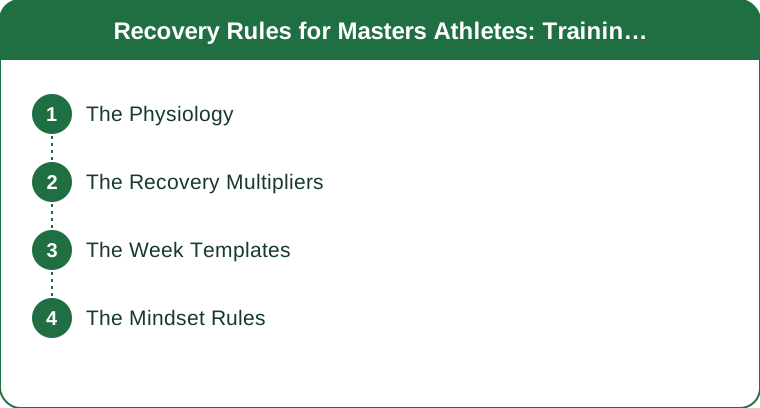
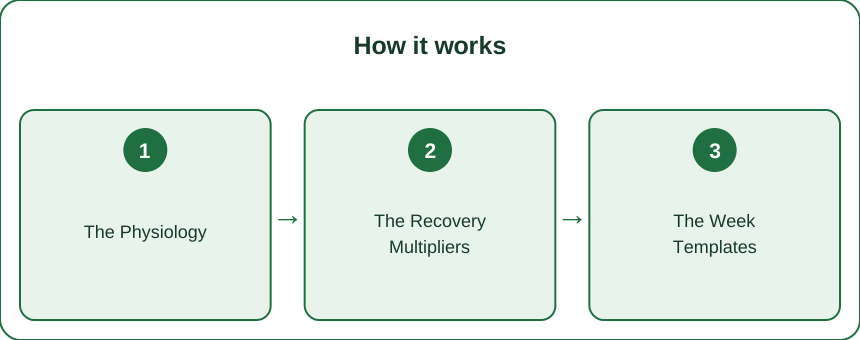
The Physiology
What changed and what didn’t: the recovery-window stretch (the same session billing more hours — the muscle-repair and glycogen timelines lengthening; the back-to-back hard days that worked at 28 becoming the injury pipeline at 48), the anabolic-resistance note (the training-and-protein stimulus needing to be LOUDER per the muscle-aging doctrine — the recovery that must also scale to match), the tissue-specific ledger (the tendons and connective tissue adapting slowest — the tendon-care patience from the tendon chapters; the muscle recovering faster than its attachments), the sleep centrality (the recovery hormone environment built overnight — the sleep quality that often degrades exactly when it matters more; the sleep chapters as masters-performance reading), and the still-adapts headline (the adaptation machinery fully functional at every masters age — the studies from the longevity chapters; the invoice longer, the gains real).
The Recovery Multipliers
The toolkit that scales: the sleep investment (the masters athlete’s first supplement being an earlier bedtime — the wind-down protocol from the evening chapters as training infrastructure), the protein arithmetic (the 1.6g-per-kilo range with 25-30g anchors — the anabolic-resistance math; the breakfast dose most skipped and most needed), the easy-day discipline (the recovery runs kept genuinely conversational — the moderate-intensity rut being the masters classic; the polarized doctrine enforced harder with age), the deload rhythm (the every-fourth-week easy block moved from optional to structural — the proactive deload beating the forced one; the deload doctrine at masters priority), the movement-recovery menu (the walking, swimming and mobility sessions as active recovery — the between-days work from the recovery chapters), and the stress-ledger honesty (the life load counted in the training math — the cortisol doctrine; the big-work-week absorbing a training week’s worth of recovery budget).

The Week Templates
Sustainable intensity structures: the hard-easy law (the hard sessions separated by 48-plus hours — the two-hard-days-max-consecutive ban; the quality-over-frequency trade), the three-intensity template (the week built on two-three hard sessions, two-three easy sessions, one-two full-rest or mobility days — the masters standard; the hard days made genuinely hard because the easy days made room), the strength non-negotiable (the twice-weekly resistance work whatever the sport — the muscle-and-tendon insurance from the masters-competition chapter; the power work included for the fast-twitch defense), the sport-specific rotations (the runner’s surface-and-volume management, the lifter’s rep-range waves, the team-sport player’s practice-versus-conditioning budget), and the season periodization (the year with planned build-and-recover blocks — the race-and-competition peaks spaced humanely; the off-season honored as the adaptation harvest).
The Mindset Rules
The head game: the data-over-ego governance (the morning readiness honesty — the heart-rate, sleep and mood check from the tracking doctrine; the planned session downgraded without drama when the body votes no), the comparison recalibration (the current self as the only benchmark — the 25-year-old PRs archived respectfully per the comeback doctrine; the age-graded scoring as the fairer mirror), the niggle protocol (the whisper answered with a down-week — the masters body’s warnings arriving quieter and mattering more; the pain doctrine at veteran stakes), the consistency identity (the masters superpower being decades-honed adherence — the training age that compensates for biological age; the twenty-year streak beating any single season), and the reframe close (recovery reframed from lost training time to the second half of training — the adaptation happening in the rest; the masters athlete who recovers like a professional performing like one; harder is still available — it just travels with smarter now). Sleep like it’s training, space the hard days, deload on schedule: the invoice, paid — the gains, kept.
After 40 the same session bills more recovery: space hard days 48+ hours, deload every fourth week, sleep and protein scaled up, easy days kept honestly easy. The body still adapts fully — the invoice is just longer.
Keep Reading
This article is for general informational and styling purposes only. Fit, sizing, and product availability may vary.