5 Recovery Habits That Actually Matter After 40
Training hard after 40 isn’t the problem most masters athletes run into — recovering from it is. These 5 habits consistently separate the athletes who keep progressing from the ones who plateau or get hurt.

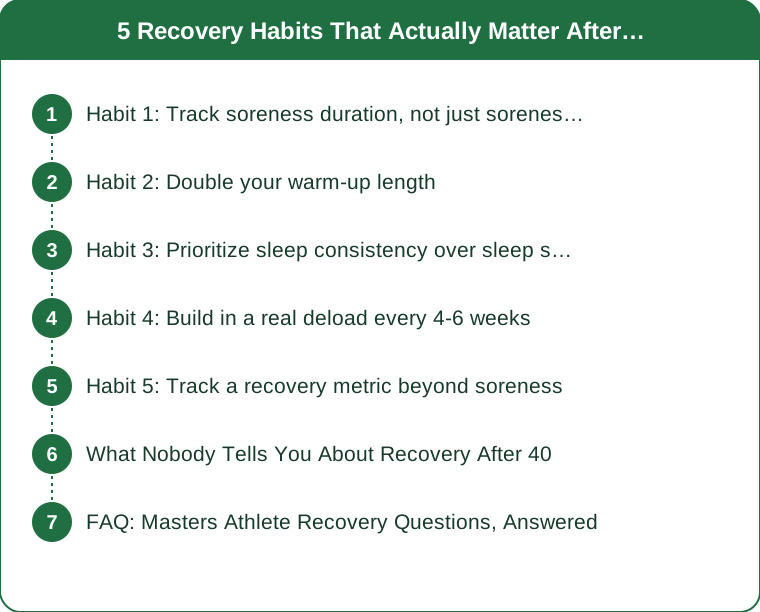
Habit 1: Track soreness duration, not just soreness intensity
In your 20s, soreness peaked and faded within 24-48 hours regardless of what you did. After 40, how long soreness lingers matters more than how bad it feels — soreness stretching past 72 hours is a signal to add a recovery day or reduce volume next session, not a badge of a good workout.
Habit 2: Double your warm-up length
Tendons and connective tissue take measurably longer to reach working temperature after 40. A warm-up that took 5 minutes at 25 now often needs 10-12 minutes of progressive, movement-specific preparation to reduce strain risk on the same lifts.
Habit 3: Prioritize sleep consistency over sleep supplements
Sleep architecture shifts with age — less deep sleep, more fragmented nights. Before reaching for a sleep supplement, a consistent sleep and wake time (even on weekends) does more to protect the deep sleep windows where most physical recovery and hormone regulation happen.

Habit 4: Build in a real deload every 4-6 weeks
Masters athletes recover more slowly between hard training blocks. A deliberate deload week — roughly 40-50% reduced volume, same movement patterns — every 4-6 weeks (versus every 8-12 weeks common in younger athletes) helps tendons and joints catch up before accumulated fatigue turns into an overuse injury.
Habit 5: Track a recovery metric beyond soreness
Soreness alone is an unreliable single indicator after 40. Adding resting heart rate or grip strength as a simple daily or weekly check gives an earlier, more objective signal that you’re under-recovered before soreness or performance drop-off shows it.
What Nobody Tells You About Recovery After 40
The biggest shift isn’t that recovery takes longer across the board — it’s that connective tissue (tendons, ligaments) recovers more slowly than muscle does, even when your muscles feel fully recovered. This mismatch is exactly why masters athletes often get tendon injuries during a phase where their strength numbers are actually climbing — the muscle outpaces the tendon’s recovery timeline.
FAQ: Masters Athlete Recovery Questions, Answered
Do I need more rest days after 40, or just different training?
Both, usually — most masters athletes benefit from one additional recovery-focused day per week compared to their 20s and 30s programming.
Is soreness a reliable sign I’m training hard enough?
Less reliable than in younger years — pair it with an objective metric like resting heart rate for a clearer picture of recovery status.
How much should a deload week actually reduce volume?
Around 40-50% volume reduction while keeping the same movement patterns tends to preserve motor skill while still allowing real recovery.
TL;DR:
- Track soreness duration (not just intensity) — past 72 hours means back off next session
- Double warm-up length to protect slower-recovering tendons
- Prioritize consistent sleep timing over supplements
- Deload every 4-6 weeks, and track an objective recovery metric alongside soreness
The goal after 40 isn’t training less — it’s recovering deliberately enough that the hard training actually sticks.
Keep Reading
This article is for general informational and styling purposes only. Fit, sizing, and product availability may vary.