Why Tendons Take Longer to Recover After 40 Than Muscles Do
Quick Answer: Tendons recover more slowly than muscles because they have far less blood supply and much slower collagen turnover — and both gaps widen after 40. The practical fix: space high-impact sessions further apart than soreness suggests, progress tendon-loading volume by roughly 10% per week or less, and warm up connective tissue deliberately before intensity. Localized tenderness over a tendon, or stiffness that won’t warm up, means back off.
Your muscles feel fine on Wednesday. So you run hard on Wednesday. And three weeks later your Achilles is angry about something you did in a session you barely remember.
This is the classic masters-athlete injury, and it isn’t a discipline problem or a bad-luck problem. Muscle and tendon simply do not recover on the same clock — and after 40 that gap gets wider.

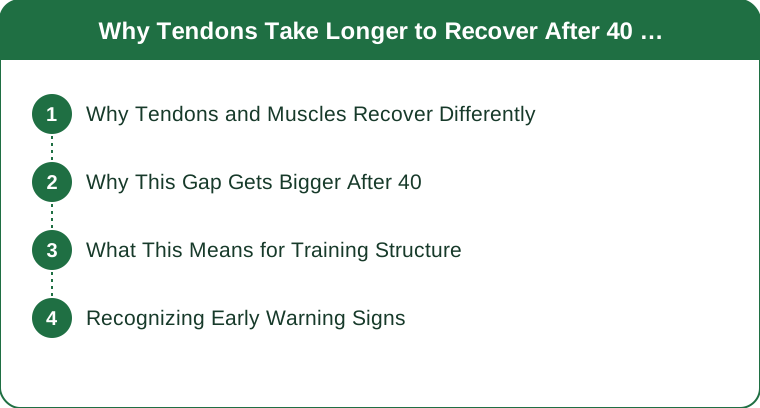
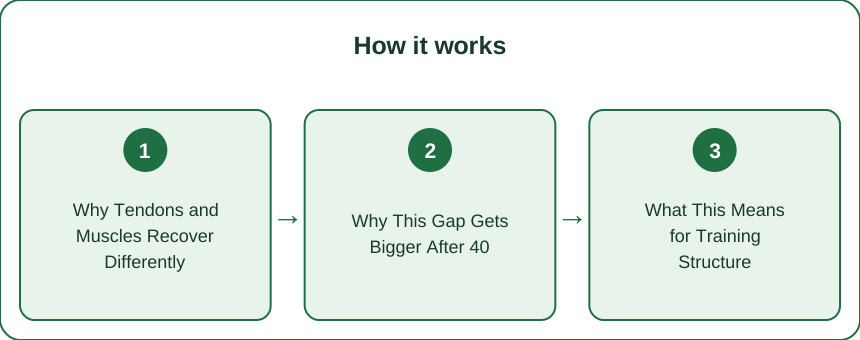
Why Do Tendons Heal Slower Than Muscles?
Three biological differences, all pointing the same direction.
Blood supply. Tendon is far less vascularized than muscle. Nutrients, oxygen, and repair signaling all arrive more slowly at a tendon than at a muscle belly, which sets a hard floor on how fast repair can happen regardless of how motivated you are.
Collagen turnover. Tendon is mostly type I collagen, and the rate at which that collagen is broken down and rebuilt is slow to begin with — measured in months for meaningful structural change, versus days for muscle protein turnover. Muscle rebuilds; tendon remodels.
Cellular density. Tendon tissue is much less cellular and less metabolically active than muscle. There’s simply less repair machinery per unit of tissue, running at a lower rate.
Put together: after a hard session, your muscle’s repair process may be substantially complete while your tendon’s is still early.
Why Does the Gap Get Bigger After 40?
Because the two tissues age at different speeds.
Blood flow to connective tissue declines further with age, on top of a baseline that was already limited. The tissue that could least afford a reduction gets one.
Collagen turnover slows more than muscle protein turnover does. Muscle recovery also declines with age — nobody’s arguing otherwise — but it declines more gently. The result is a widening gap rather than a uniform slowdown.
And here’s the trap: your perception tracks muscle, not tendon. Soreness is a muscle signal. When the soreness fades, your brain reports “recovered” — while the tendon is still mid-repair. You’re being given a false readiness signal, and you’re acting on it in good faith.
That’s the whole mechanism behind the injury that seems to come from nowhere. It didn’t. It came from the last four sessions you felt fine during.

How Should Masters Athletes Structure Training Around This?
Four adjustments, none of which require training less overall.
1. Progress tendon-loading volume slowly. For running mileage, jump volume, or plyometrics, the old 10% per week guideline is a reasonable ceiling — and past 40, treating it as a ceiling rather than a target is wiser still. Muscle can handle faster progression. Tendon sets the speed limit.
2. Space high-impact sessions by tendon logic, not soreness logic. If soreness says 48 hours, consider 72 for the sessions that load tendons hard — sprint work, plyometrics, heavy jumping, downhill running. Filling the gap with low-impact work (cycling, swimming, upper body) keeps volume up without the connective-tissue cost.
3. Warm up connective tissue deliberately. A tendon-focused warmup means progressive loading, not just raised heart rate: 10–15 minutes working from easy movement through submaximal loaded reps of the specific pattern before you go hard. Tendons are viscoelastic — they genuinely behave differently warm than cold.
4. Load tendons on purpose, slowly. This is the part people miss: tendons adapt to loading, and the loading that builds them is slow and heavy, not fast and explosive. Heavy slow resistance work — think 3–4 sets of 6–8 reps at a 3-second lowering tempo — is well supported as a way to build tendon capacity. The goal isn’t to avoid loading tendons. It’s to load them in the way they respond to, and give them time.
What Are the Early Warning Signs?
Two signals are worth acting on immediately, because both distinguish tendon trouble from ordinary training soreness.
Localized tenderness directly over a tendon. Muscle soreness is diffuse — a whole region feels worked. Tendon pain is specific: you can put one finger on it. If you can point to it precisely, treat it as a tendon signal and adjust.
Stiffness that doesn’t warm up. Normal muscle stiffness eases within the first 10 minutes of activity. Tendon-area stiffness that persists through a full warmup — or that’s worst in the first steps out of bed — is a classic early tendinopathy pattern, and it’s the signal most often ignored because “it loosens up eventually.”
Other flags: pain that shows up the day after rather than during, and pain that improves with activity but returns worse afterward.
What to do: reduce the tendon-loading volume (not necessarily all training), keep loading it gently rather than resting completely — complete rest tends to leave tendons weaker — and give it real time.
When to see a professional: if localized tendon pain persists beyond 2–3 weeks despite reduced loading, if it’s affecting your gait, or if there was any sudden sharp pain or a snapping sensation, see a physical therapist or sports medicine doctor. Tendinopathy caught early is a matter of weeks of managed loading. Left to run, it becomes a matter of months.
One small comfort: none of this means training less as you age. It means sequencing it differently — and the athletes who figure that out in their forties tend to still be training in their sixties. Do the low-impact filler days in whatever’s comfortable; a pair of high waist yoga leggings and an easy bike or swim session is doing more for your tendons than another hard run would.
Mini FAQ
How long do tendons take to recover compared to muscles?
Muscle recovery from a hard session is typically measured in 24–72 hours, while meaningful tendon remodeling is measured in weeks to months. That’s why soreness is such an unreliable guide to whether you’re ready for another high-impact session.
Can you train while recovering from tendon pain?
Usually yes, and often you should — complete rest tends to leave tendons weaker and slower to return. Reduce the specific loading that aggravates it, keep loading it in a pain-tolerable range, and get a professional assessment if it isn’t improving in 2–3 weeks.
Does stretching help tendon recovery?
Aggressive static stretching of an irritated tendon often makes it worse, since it adds tensile load to already-irritated tissue. Progressive loading — heavy, slow resistance work in a tolerable range — has much better support for building tendon capacity.
TL;DR:
- Tendons heal slower than muscle because of low blood supply, slow collagen turnover, and low cellular density.
- After 40 the gap widens — and soreness tracks muscle, giving you a false readiness signal.
- Progress tendon-loading volume at ≤10% per week and space high-impact sessions ~72 hours apart.
- Warm up connective tissue for 10–15 minutes with progressive loading, and build tendons with heavy, slow resistance work.
- Localized, pointable tenderness or stiffness that won’t warm up = back off; see a professional if it persists past 2–3 weeks.
Keep Reading
This article is for general informational and styling purposes only. Fit, sizing, and product availability may vary.