Training After 40: The Five Things That Actually Change (Not the Ones You'd Guess)
Quick Answer: After 40, recovery time, tendon healing speed, warm-up needs, grip and tendon resilience, and injury risk from sudden intensity spikes are the areas that genuinely change — raw strength and muscle-building capacity remain very trainable well past 40 with the right adjustments.
The assumption is that everything gets harder after 40. In practice, it’s a specific short list of changes — and most of them are manageable with small adjustments, not a wholesale rebuild of how you train.

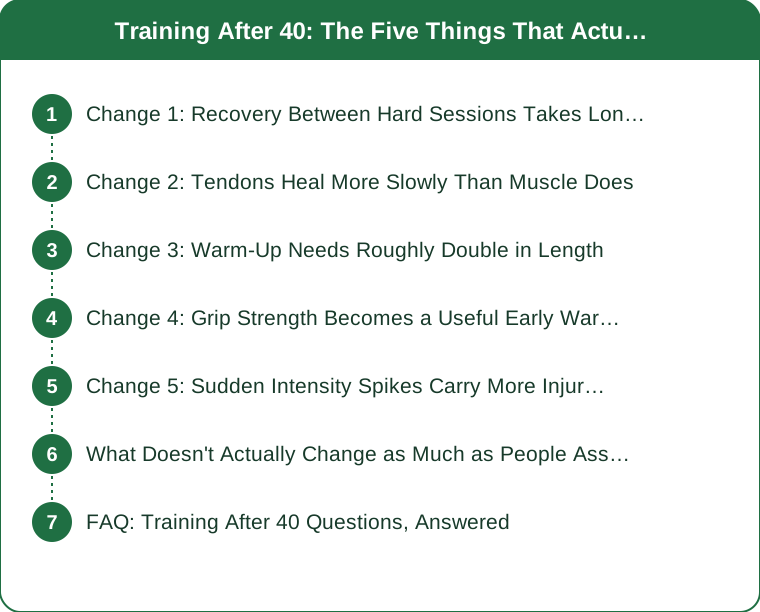
Change 1: Recovery Between Hard Sessions Takes Longer
The time needed between high-intensity sessions to fully recover tends to lengthen gradually after 40, meaning the same training frequency that worked at 30 may need slightly more spacing between the hardest days to avoid accumulating fatigue.
Change 2: Tendons Heal More Slowly Than Muscle Does
Tendon tissue has lower blood flow than muscle and its repair process slows more noticeably with age, which is part of why tendon-related issues (not muscle strains) become a more common limiting factor for masters athletes specifically.
Change 3: Warm-Up Needs Roughly Double in Length
A warm-up that took 5 minutes at 25 may need closer to 10-12 minutes after 40 to adequately prepare joints and tissue for heavier loads — skipping this adjustment is a common contributor to nagging, low-grade injuries in masters lifters.

Change 4: Grip Strength Becomes a Useful Early Warning Signal
Grip strength decline can be an earlier, more visible signal of overall recovery status than other markers, making it a practical daily check-in — a noticeably weaker grip than usual on a given day often correlates with needing a lighter session.
Change 5: Sudden Intensity Spikes Carry More Injury Risk
Jumping straight into a much higher intensity than your recent training baseline carries disproportionately more injury risk after 40 compared to a gradual ramp — this is less true for younger athletes with faster adaptive recovery.
What Doesn’t Actually Change as Much as People Assume
Raw strength gains and muscle-building capacity remain genuinely trainable well into your 40s, 50s, and beyond — studies on masters athletes consistently show meaningful strength and hypertrophy gains possible with structured training, contrary to the assumption that progress simply stops.
The ceiling on performance doesn’t drop as sharply as commonly believed — what changes is more about the path to get there (recovery spacing, warm-up length, gradual intensity increases) than the destination itself being out of reach.
FAQ: Training After 40 Questions, Answered
Should training volume decrease significantly after 40?
Not necessarily — many masters athletes maintain similar volume with better spacing and recovery planning, rather than simply doing less overall.
Is it too late to start strength training for the first time after 40?
No — plenty of research shows meaningful strength gains for previously untrained adults starting well into their 40s and beyond.
How should someone tell the difference between normal soreness and a tendon issue after 40?
Muscle soreness typically peaks 24-48 hours post-workout and fades; tendon pain tends to be more localized, persistent, and often worsens with continued loading rather than resolving on its own — worth a professional look if it lingers.
TL;DR:
- Recovery time and tendon healing genuinely slow down, but strength-building capacity doesn’t disappear
- Warm-ups roughly doubling in length is one of the most impactful, low-effort adjustments
- Grip strength can serve as a practical daily readiness signal
- Gradual intensity increases matter more after 40 than they did in your 20s
The list of what changes is shorter than most people assume — and every item on it is manageable with a few deliberate adjustments, not a full retreat from hard training.
Keep Reading
This article is for general informational and styling purposes only. Fit, sizing, and product availability may vary.