What a Real Training Week Looks Like After 45
Quick Answer: A sustainable masters training week is usually three quality sessions, two easy ones, and two genuinely unstructured days. The change after 45 is not less work — it is more separation between hard days, because recovery, not willingness, becomes the ceiling.
Nobody hands you a memo when the math changes.
You just notice that the week which used to feel productive now feels like being slightly behind on everything, and that the session which used to cost you an afternoon now costs two days.
Here is what an ordinary week actually looks like when it is built around that reality instead of against it.

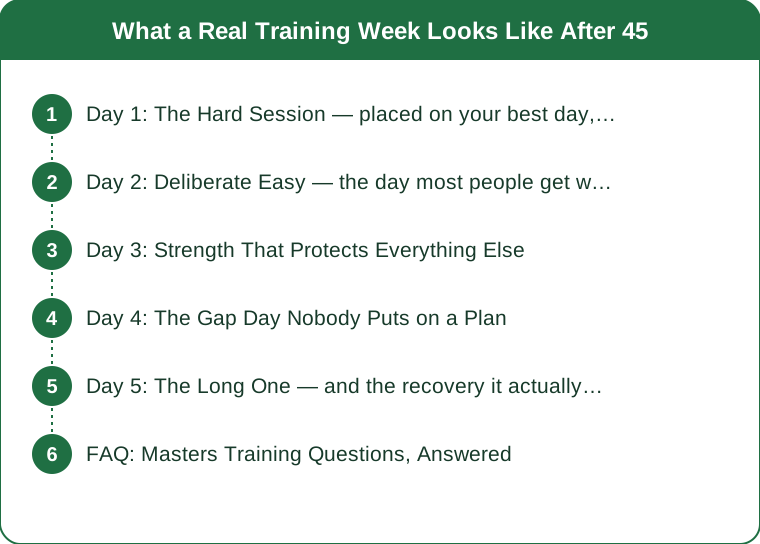
Day 1: The Hard Session — placed on your best day, not Monday
The first snapshot is a Tuesday, not a Monday, and that is deliberate.
Most people put their hardest work on Monday because it feels disciplined. But Monday follows a weekend of yard work, family logistics, and probably a later Saturday night — the exact conditions that produce a mediocre hard session.
Move the key session to whichever day follows your best sleep. For most people that is Tuesday or Wednesday.
What the session looks like: a genuinely thorough warm-up of 12 to 15 minutes, then the actual work — intervals, heavy sets of 3 to 5, or a tempo effort. The work portion is often only 20 to 30 minutes. The warm-up is not optional padding after 45; it is the difference between adapting and getting hurt.
One quality session executed well beats three mediocre ones, and this is the day that decides whether the week produced anything.
Day 2: Deliberate Easy — the day most people get wrong
The second snapshot is the day after, and it is genuinely easy.
This is where masters training diverges most sharply from what worked at 30. Easy days used to be a nice idea. Now they are the mechanism — the day that lets the hard day actually turn into adaptation.
The test is simple: can you hold a full conversation the entire time? If the answer is no, it was not an easy day, and you have just made your next hard day worse.
Practically this looks like a 30 to 45 minute walk or very light jog, or an easy swim, or 20 minutes of mobility followed by nothing. Heart rate stays low. Nothing burns.
The psychological difficulty of this day is real and worth naming. It feels like doing nothing. It is not doing nothing — it is the part of the process where the previous day becomes fitness rather than just fatigue.
Day 3: Strength That Protects Everything Else
The third snapshot is the strength session, and after 45 its purpose shifts.
In your thirties, lifting was performance. Now it is primarily tissue insurance — maintaining the muscle mass and tendon resilience that keeps everything else possible, with performance as a welcome side effect.
The session is shorter than people expect: two lower-body movements, two upper-body, one carry or core piece. Sets of 5 to 8 at a weight where the last rep is solid rather than desperate.
Three specifics that matter more now:
- Never skip the loaded carry. Suitcase carries, farmer’s walks — they build the trunk stability that protects your back during everything else in the week.
- Add one single-leg movement. Balance and unilateral strength decline earlier than raw strength and matter more for injury prevention.
- Leave two reps in reserve on most sets. Training to failure costs recovery you cannot afford to spend twice a week.

Day 4: The Gap Day Nobody Puts on a Plan
The fourth snapshot is a day where nothing is scheduled, and it is on purpose.
Every functional masters week contains at least one true gap — not a rest day with a mobility routine attached, an actual gap. Life fills it: a work trip, a kid’s game, a day where your back is tight for no reason.
Building the gap in advance means life does not have to break the plan to fit. Plans without slack fail at the first unscheduled Tuesday, and then people conclude they lack discipline when what they lacked was margin.
What often happens on this day: a long walk with someone, a bike ride that is not training, playing something. The unstructured movement has real value, but its main function is that the week survives contact with reality.
If you finish a week having done everything on paper, the paper was probably too easy.
Day 5: The Long One — and the recovery it actually costs
The final snapshot is the weekend long session, and the honest part is the accounting afterward.
Long efforts still work well after 45 — endurance holds up better with age than top-end speed does. What changes is the tail. A long ride or run that used to cost an afternoon now shows up as flatness on Monday and sometimes Tuesday.
Plan the two days after the long session, not just the session. That means the following Monday is easy or a gap day, always.
Three practical adjustments that make long days repeatable:
- Eat during, not just after. Carbohydrate during efforts over 90 minutes noticeably reduces the recovery cost. This becomes more true with age, not less.
- Cap the duration before you start. Deciding mid-effort to add 30 minutes is where most overreaching happens.
- Protect the sleep that night specifically. It is the highest-leverage 60 minutes in the entire week.
Five snapshots, three real sessions, two easy, two gaps. That is the whole architecture — and the reason it works is that the easy parts are treated as seriously as the hard ones.
This is general information, not medical advice. Persistent joint pain or unusual fatigue is worth a conversation with a professional.
FAQ: Masters Training Questions, Answered
Am I supposed to train less overall after 45?
Usually not less total volume — less hard volume, with more separation between quality days. Many masters athletes actually maintain or increase easy volume while dropping from four hard sessions per week to two or three.
How long should recovery between hard sessions be?
Most people do well with 48 to 72 hours between genuinely hard efforts, versus 48 in their thirties. The tell is whether you can hit the intended intensity on the next quality day. If you consistently cannot, the gap is too short.
Does this mean I have to give up racing or competing?
No. Masters athletes compete well into their seventies and beyond. What changes is the structure that gets you there — fewer, better-executed hard sessions and a genuinely protected recovery scaffold around them.
TL;DR:
- Three quality sessions, two easy, two gap days is the durable shape of a masters week.
- Put the hard session after your best sleep, not automatically on Monday.
- Easy days are the mechanism, not filler — full-conversation pace or it does not count.
- Strength work is tissue insurance now; carries and single-leg work earn their spot.
- Plan the two days after your long session, not just the session itself.
The week that works after 45 looks lazier on paper and produces more. That trade is uncomfortable for anyone who built their identity on grinding, and it is also the reason some people are still going strong at 60 while others quietly stopped at 50.
Keep Reading
This article is for general informational and styling purposes only. Fit, sizing, and product availability may vary.